
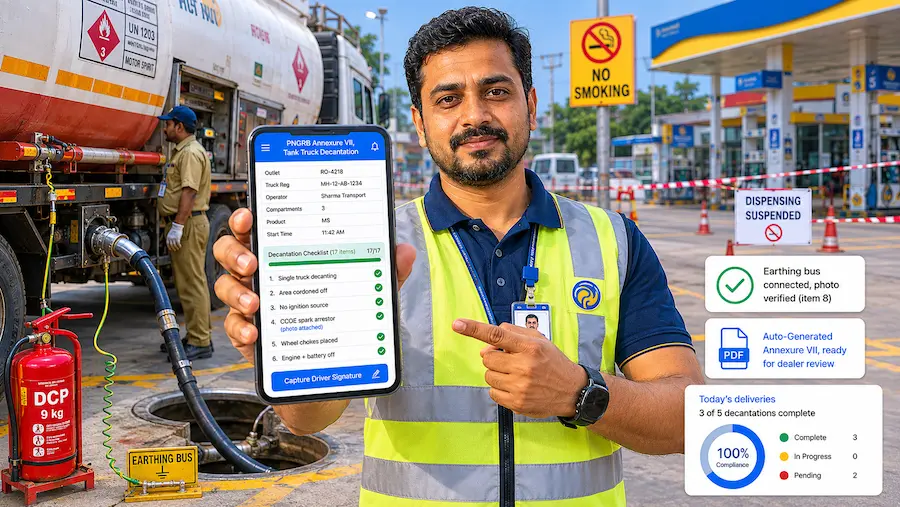
PNGRB Schedule 1 mandates a safety checklist every single time a tank truck unloads fuel at a petroleum retail outlet. The format sits in Annexure VII and runs through 17 items covering positioning, ignition control, earthing, hose integrity, fire equipment, mobile phone restrictions, and crew presence. At a busy outlet with 3 to 6 deliveries a day, that's over 1,100 checklists a year. On paper, this is nearly impossible to maintain. This article walks through every item in the regulation, the two signatories required, what TPIA auditors look for, and how a Clappia PNGRB audit checklist app turns the per-decantation safety check into a 90-second mobile job. For the wider stack, see the parent PNGRB audit checklist guide.
Annexure VII, titled "Safety Checklist for Tank-Truck Decanting at Retail Outlet", sits inside Schedule 1 of the PNGRB Technical Standards and Specifications including Safety Standards (T4S) Regulations. It is the format mandated for every fuel unloading event at every petroleum retail outlet in India.
The format has three blocks. Header block: date, time, and outlet identification. 17-item check block: each item with a "Check" column where the supervisor ticks compliance. Sign-off block: two signatures, one from the tank truck driver and one from the name/designation of the authorised RO staff supervising the decantation. The closing line of the format reads: "Verified that all precautions have been taken with regard to decantation as detailed above."
The regulation also notes a "Note on numbering": the printed format skips item 14 entirely and duplicates the engine-off-and-battery-switch-off check at items 6 and 10. This is exactly how it appears in the official regulation, so a digital version should reflect the same numbering to remain audit-compliant.
Decantation is the highest-risk routine activity at any retail outlet. Combustible vapour, an open fill point, a moving truck, an engine that was running until moments ago, a driver and crew handling hoses, customers possibly nearby. Most refinery-to-retail incidents in India have involved a decantation event going wrong.
What can go wrong without the checklist. A tank truck without a spark arrestor pulls in next to an open fill point. A dispenser stays operational on the next pump while unloading happens, creating an ignition source from a customer's vehicle. The dip pipe of the underground tank gets left open, releasing vapour into the manhole chamber. The rubber hose used does not have the external continuity wire, breaking the earthing circuit. Someone uses an unbonded plastic bucket to draw a sample, generating static. A driver leans against the truck and lights a cigarette to pass the time.
The 17-item checklist exists because every one of these scenarios has happened somewhere. Running it for every decantation is not paperwork. It is the single most important safety routine at the outlet.
The full list, in the order they appear in the regulation. The numbering anomaly (skip from 13 to 15, duplicate at 6 and 10) is preserved exactly as it appears in the official format, so audit references match.
| # | Activity | What the RO supervisor verifies |
|---|---|---|
| 1 | Only one tank truck being decanted at the retail outlet at a given time | If a second tanker is already unloading, the second one waits outside the forecourt. |
| 2 | Tank truck positioned in the demarcated area and area cordoned off | Painted markings on the forecourt, barricades or cones around the truck. |
| 3 | No ignition source in the vicinity of the tanker | Visual sweep, no lit cigarettes, no naked flame, no spark-producing tools. |
| 4 | Tank truck has CCOE-approved spark arrestor | Spark arrestor visible at the truck's exhaust, CCOE approval marking present. |
| 5 | Parking brakes and gear engaged, wheel chokes placed to prevent movement | Visual check, chokes positioned under at least one wheel on each side. |
| 6 | Tank truck engine switched off, battery switch in 'off' position | Both verified physically before unloading hoses are connected. |
| 7 | 'No Smoking' board displayed prominently | Visible from every direction of approach during the decantation. |
| 8 | TT connected to the earthing bus, proper bonding done; leakproof coupling on hoses both sides | Earthing bus cable clamped to the truck chassis BEFORE any hose connection. Hose couplings tight on tank side and tanker side. |
| 9 | Dip pipe of the underground tank kept closed during decantation | The dip pipe opening must be sealed to prevent vapour accumulation in the manhole chamber. |
| 10 | Tank truck engine switched off, battery switch in 'off' position | Re-verification before each compartment is unloaded (this is item 6 duplicated in the regulation for emphasis). |
| 11 | Mobile phones of tank truck crew and RO staff switched off / not to be operated | Phones must not be used in the decantation area at any time during unloading. |
| 12 | 10 kg / 9 kg DCP fire extinguisher of the tank truck taken out, kept next to the tank truck | The truck's own extinguisher is taken off its mount and positioned where it's immediately accessible. |
| 13 | Fire buckets easily accessible | Outlet's own fire buckets visible and reachable from the decantation area. |
| 15 | Rubber hose with external continuity wire and suitable end coupling only | The hose must have the external bonding wire visible. Hoses without continuity wire are not permitted. (Note: item 14 is intentionally skipped in the regulatory format.) |
| 16 | Only bonded metallic bucket used for drawing samples | Plastic buckets generate static and are prohibited for sample drawing. |
| 17 | Driver, khalasi (helper), and designated RO supervisor present during the entire process | No one leaves the decantation area until unloading is complete and hoses disconnected. |
Two signatories, both physically present during decantation:
The tank truck driver signs first. The driver is responsible for the truck-side conditions: spark arrestor presence, engine and battery state, parking brakes, the truck's own fire extinguisher position, and that the crew (driver and khalasi) stays on site.
The designated retail outlet supervisor signs second. The supervisor verifies the outlet-side conditions: demarcated area, no ignition source, earthing bus connection, dip pipe closure, hose continuity wire, sample bucket type, mobile phone discipline among RO staff.
Both signatures must be on the checklist before unloading is recorded as complete. The regulation does not require a third party (like the dealer) to co-sign, but most oil marketing companies have internal SOPs requiring the dealer to verify the next day, which a digital workflow handles via an approval step.
Per clause 6.2.1 of the regulation, two more verifications happen alongside the safety checklist:
The supply point documents check for seal numbers, number of compartments on the tank truck, and quantity/product contained per compartment. The supervisor cross-verifies the documents against what the truck actually carries, before unloading starts.
The operating procedure display board must be present at the decantation area, showing the unloading procedure step by step, in the local language.
Both of these are static (the procedure display) or supply-document-specific (the seal/compartment check), but they get reviewed during the annual Annexure V audit as part of Section 1 statutory requirements. A digital Annexure VII app can capture the seal/compartment data inline with the safety checklist so the two events are linked.
Identity and timing: outlet code, date, decantation start time (auto-captured), decantation end time (auto-captured), tank truck registration number (single-line text or QR scan if the OMC's truck fleet uses QR-tagged vehicles), tank truck operator/contractor name, supply point of origin, product (MS, HSD, etc.), number of compartments, quantity per compartment, seal numbers per compartment.
Crew identity: driver name and licence number, khalasi name, RO supervisor name and designation, GPS coordinates at the start of the decantation.
The 17 checks: each as a Yes/No toggle with a conditional photo upload that becomes mandatory if any item is marked "No" (which should block decantation, not just log the failure). Specific high-evidence items: photo of the CCOE spark arrestor (item 4), photo of the earthing bus connection (item 8), photo of the closed dip pipe (item 9), photo of the rubber hose showing the external continuity wire (item 15), photo of the bonded metallic sample bucket (item 16).
Closure: closure time, any incident or observation noted during decantation, driver digital signature, RO supervisor digital signature.
System-side: dealer approval task triggered after submission for next-day review, link to the parent outlet's annual Annexure V audit register, severity tag if any item was "No", auto-generated PDF in the Annexure VII format.
| Annexure VII need | Clappia feature |
|---|---|
| Scan the tank truck QR / barcode to pre-fill registration, contractor, fleet history | QR code and barcode scanner auto-fills truck data on form open |
| Capture seal numbers and compartment-wise quantity at the start, before unloading | Repeating section block, one row per compartment with seal number and quantity |
| Mandatory photo on every "No" response, before unloading can proceed | Camera and file upload block with conditional logic |
| Photos of spark arrestor, earthing bus, closed dip pipe, hose continuity wire, sample bucket | Camera blocks with mandatory upload on items 4, 8, 9, 15, 16 |
| Prove the RO supervisor was physically at the decantation | GPS location block auto-captures at form open |
| Driver and RO supervisor digital signatures | Digital signature blocks, two separate fields |
| Auto-generate sequential checklist number, one per decantation | Unique ID block with date prefix, e.g. ANX7-RO4218-30May26-001 |
| Block submission until all 17 items are answered and all required photos uploaded | Formula block with validation rule |
| Auto-generated PDF in the Annexure VII format with both signatures and photos | Print Settings templates that mirror the regulatory layout |
| Route next-day review to the dealer for verification and counter-acknowledgement | Approval workflows with daily morning task |
| Critical alerts if any item is "No" (incident, equipment failure, missing fire extinguisher) | WhatsApp, Slack, email, and SMS workflow nodes |
| Annual decantation log feeding into Section 1 of Annexure V audit | Live dashboards with filters by outlet, truck, supplier, month, non-conformity rate |
| Run the checklist at outlets with poor connectivity | Offline mode by default on Android and iOS |
Build your PNGRB Annexure VII tank truck decantation app on Clappia in minutes, with photo evidence, two-party signatures, and dashboard-ready records.
Get Started For FreeA typical retail outlet receives 3 to 6 tank truck deliveries a day, depending on volume. Each one is a separate decantation event with its own Annexure VII checklist. That's 1,100 to 2,200 checklists per outlet per year. Paper can't keep up.
Tank truck arrives: the RO supervisor opens the app, scans the truck QR code (or types the registration), and the form pre-fills truck operator, last delivery date, and historical compliance score. The supervisor walks the 17 items, taking photos of the spark arrestor, earthing connection, closed dip pipe, and hose. If item 4 is "No" (no spark arrestor), the form blocks submission and the supervisor refuses unloading. The driver signs digitally. The supervisor signs digitally.
Unloading begins: the submission appears as "In Progress" on the dashboard. At unloading completion, the supervisor reopens the entry, enters the end time, any observations, and submits final. A WhatsApp goes to the dealer with the auto-generated PDF for next-day review and counter-acknowledgement.
Trend tracking: across 60 days, the dashboard shows which truck operators have the highest "No" rate (typically items 4 spark arrestor, 12 truck's own fire extinguisher, 17 crew presence). The dealer takes this to the supplier with names and dates.
A network supply chain lead at an oil marketing company manages tank truck deliveries to 240 outlets through 60 contracted trucking operators. Before going digital, Annexure VII checklists sat in paper books at each outlet. Audit verification meant sampling 5 percent of outlets per quarter to physically inspect the books, which caught about 10 percent of compliance gaps.
After moving to the Clappia template, every decantation generates a digital checklist with truck QR, photos, and two-party signatures. The dashboard surfaces the pattern: 4 of the 60 trucking operators were responsible for 70 percent of "No" entries on item 4 (spark arrestor) and item 17 (crew leaving early). The lead used the data to renegotiate contracts with two underperforming operators, and overall network decantation compliance moved from "best guess" to a measured 99.2 percent in the first quarter.
The decantation checklist is the highest-frequency single-event check in the PNGRB stack. Use it alongside the PNGRB Annexure III weekly inspection checklist, which checks the tank farm and bonding wire condition every seven days; the PNGRB Annexure V annual safety audit checklist, whose Section 7 reviews the tank lorry side of decantation; the PNGRB Annexure IV electrical audit checklist for earthing infrastructure that the decantation depends on; the PNGRB Annexure VI(a) operator work permit for any unrelated maintenance suspended during decantation; and the PNGRB Annexure VI(b) hot work permit for high-risk work that must wait for the truck to leave. The parent PNGRB checklist guide ties every annexure together.
Two signatories: the tank truck driver and the designated retail outlet supervisor (named RO staff member who supervises the decantation). Both must be physically present throughout the unloading.
No. The regulation suspends all dispensing operations to motor vehicles during the unloading of fuel from tank truck to storage tanks. This is to prevent any ignition source from a customer's vehicle. The outlet effectively pauses sales for the duration of the decantation (typically 20 to 45 minutes per truck).
The dip pipe is the manual gauging opening into the underground tank. If it's left open during fuel transfer, vapour rising from the tank can accumulate in the manhole chamber and the surrounding zone. The regulation specifically calls this out (item 9) to prevent vapour build-up that could ignite from any nearby source.
The Chief Controller of Explosives (now under the Petroleum and Explosives Safety Organisation, PESO) approves spark arrestor designs for tank trucks transporting petroleum products. The device fits on the truck's exhaust and prevents engine sparks from escaping. Trucks without CCOE approval cannot legally deliver fuel to a retail outlet.
For the entire duration of unloading. The supervisor cannot delegate mid-decantation. If the supervisor needs to leave for any reason, decantation must be paused until the supervisor or a properly briefed replacement returns. This is captured in item 17 of the checklist.
Decantation should not proceed. The truck driver is asked to correct the condition (re-park, re-bond, fix the spark arrestor, etc.) before unloading begins. If the condition cannot be corrected on site (e.g., missing CCOE-approved spark arrestor), the truck is turned away and the supplier is notified. A digital checklist blocks submission until all 17 items are "Yes" or an explicit override with approval is captured.
Decantation is the highest-volume, highest-risk routine on the PNGRB stack. Every tank truck delivery, every day, every outlet, needs a signed 17-item checklist with two signatures and photo evidence. Paper at this volume is a losing battle, and TPIAs know it. A digital workflow makes the check a 90-second job, surfaces problem trucks and operators in the dashboard, and gives the dealer a clean, signed register that the annual Annexure V audit can read in seconds.
Ready to run Annexure VII without paper? Sign up for free and build your tank truck decantation app on Clappia in under 30 minutes. No credit card, no contracts, no risk, just results.
 Get Started – It’s Free
L374, 1st Floor, 5th Main Rd, Sector 6, HSR Layout, Bengaluru, Karnataka 560102, India
3500 S DuPont Hwy, Dover,
Kent 19901, Delaware, USA


.svg)




3500 S DuPont Hwy, Dover,
Kent 19901, Delaware, USA
L374, 1st Floor, 5th Main Rd, Sector 6, HSR Layout, Bengaluru, Karnataka 560102, India