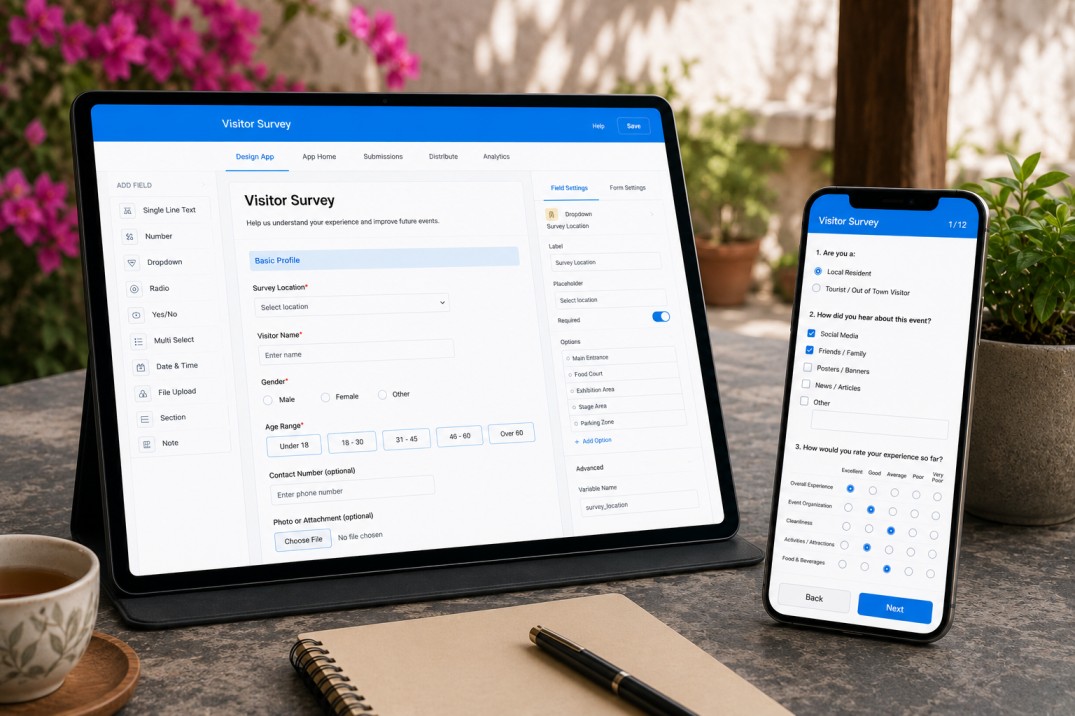

.avif)
Most businesses start managing daily orders the same way: a shared spreadsheet, a handful of columns, and a team that knows how it works. For a while, it gets the job done. But as order volumes grow, as more people start filling in the sheet, and as product lists and client terms get more complex, the cracks start showing. Prices get entered manually and don't match the agreed discount. Tax calculations vary from one person to the next. Product names are spelled differently across rows, making it nearly impossible to aggregate data reliably.
The frustrating part is that none of this happens because people are careless. It happens because spreadsheets are not designed for structured, repeatable data entry. They are flexible by nature, and that flexibility is exactly the problem when you need consistency.
This article compares what daily order management typically looks like in a spreadsheet versus how the same process works when moved to a structured no-code form in Clappia. Along the way, you will also get a practical walkthrough of how to build the setup from scratch.
Before jumping into the solution, it is worth being specific about what actually goes wrong with spreadsheets, because the issues are more operational than people realize.
Manual discount calculations introduce errors at every entry. When a sales rep or field agent has to remember a client's discount rate and apply it manually, mistakes happen. And because there is no validation, a wrong number simply gets saved and carried forward.
Tax splits are calculated inconsistently. Whether you split taxes into two components (as is the case with GST in India, which divides into CGST and SGST), apply a single rate, or use different rates for different product categories, doing this manually in a spreadsheet is error-prone. One person rounds differently, another forgets to back-calculate from a tax-inclusive price. The result is billing data that does not match.
Product names and codes are not standardized. Without a master list enforced at the point of entry, the same product ends up recorded across different rows. Any attempt to report or aggregate by product then requires a cleanup step before you can trust the numbers.
There is no enforcement at entry time. Spreadsheets cannot stop someone from leaving a required field blank, entering a date that makes no operational sense, or submitting a quantity of zero. Every error has to be caught after the fact, usually by someone manually reviewing the sheet.
Spreadsheets give you flexibility. Order management needs structure. The two are fundamentally in tension.
The alternative is not necessarily a complex ERP or a custom-built application. A well-structured no-code setup in Clappia can solve all of the above with three connected apps: a product master, a client/shop master, and an order entry form that links to both.
Here is how the three apps divide the responsibility:
| App | What It Does |
|---|---|
| Product Master | Stores standardized product names, codes, pricing, tax rates, and shelf life |
| Client/Shop Master | Stores client-specific commercial terms: price category, discount, tax ID, route |
| Order Entry App | Links to both masters, auto-fills pricing and tax data, calculates totals, validates inputs |
This is just one example of how this can be structured, and you can adapt it to your own product and client setup. The underlying logic applies to any business that takes daily orders from a defined set of clients across a defined product catalogue.
The Product Master is the single source of truth for your product catalogue. Once a product is recorded here, anyone placing an order selects from this list rather than typing a product name manually.
In your Clappia dashboard, click on New App and go to Design App. Add the following fields in a single section:
Required fields:
Optional fields:
No formulas or display conditions are needed in this app. It is pure reference data. Once you have created the app, populate it with your product records. You can do this one by one from App Home, or if you have existing data, upload all records in one go from the Submissions tab using the bulk upload option.
For more on setting up input fields, see Data Input Blocks in Clappia.
This app stores the commercial terms for each client or shop you supply to. These are the details that should never be entered manually at the point of order, because they are agreed in advance and should be locked in.
Create a new app and add these fields:
Required fields:
Optional fields:
Again, no formulas are needed here. This is reference data. Populate it with your client records the same way you did for the product master.
This is where the two masters come together. The order entry app uses Get Data from Other Apps blocks to link to both masters, auto-fills the relevant commercial and product data, and then runs all the pricing and tax calculations in the background.
Add two Get Data from Other Apps blocks to your order entry app.
Lookup 1: Select Client
Lookup 2: Select Product
Keeping all pulled fields hidden except Listed Price and Supply Type means the form stays clean. The user sees only what they need to act on. All the reference data exists in the submission and is available for reporting, but it does not clutter the entry screen.
For more on how the Get Data block works, including how to configure which fields are visible versus pulled in the background, see the Fetch Data from Other Clappia Apps guide.
These are the fields the person placing the order fills in themselves:
This is where the no-code setup decisively outperforms a spreadsheet. All six pricing fields are Calculation & Logic blocks set to Hidden, meaning the user never sees them but the values are always calculated correctly and stored with every submission.
To add a formula field, go to Design App, click Add Field, and select Calculation & Logic. After entering the formula, enable the Hidden toggle so the field does not appear on the form.
{listed_price} - {listed_price} * ({discount} / 100)
Fields used: Listed Price (from product master), Discount (from client master)
What it does: Applies the client-specific discount to the listed price to get the effective selling rate for this order.
Example: Listed Price = 100, Discount = 10% → Rate After Discount = 90
({rate_after_discount} * 100) / (100 + {tax_rate})
Fields used: Rate After Discount, Tax Rate
What it does: Since listed prices are typically tax-inclusive, this formula back-calculates the pre-tax base rate. This is the figure on which tax is then applied to get the correct split.
Example: Rate After Discount = 90, Tax Rate = 12% → Base Rate = 80.36
{base_rate} * {quantity}
Fields used: Base Rate, Quantity
What it does: Multiplies the pre-tax rate by the quantity ordered to get the total pre-tax value of the order line.
Example: Base Rate = 80.36, Quantity = 10 → Total Base = 803.6
({total_base} * ({tax_rate} / 100)) / 2
Fields used: Total Base, Tax Rate
What it does: Calculates the first half of the tax. In tax systems that split a single rate into two equal components (such as GST in India, which splits into CGST and SGST), this gives you one component. If your tax system uses a single rate without splitting, you can use the full formula in Formula 6 without these intermediate steps.
Example: Total Base = 803.6, Tax Rate = 12% → First Tax Component = 48.22
({total_base} * ({tax_rate} / 100)) / 2
Fields used: Total Base, Tax Rate
What it does: The second equal half of the split tax. Both components sum to the full tax amount on the order.
Example: Second Tax Component = 48.22
{total_base} + {first_tax_component} + {second_tax_component}
Fields used: Total Base, First Tax Component, Second Tax Component
What it does: The final tax-inclusive total for the order line. This is the number that goes to accounting.
Example: 803.6 + 48.22 + 48.22 = 900.04
All six formula fields remain hidden. The user does not need to see any of them during order entry. The data is stored in the submission and is available in the Submissions view, in exports, and in analytics. For a full reference of supported formulas, see Using Formula Block in Clappia.
One of the clearest differences between a spreadsheet and a structured form is that a form can refuse to accept invalid data. In Clappia, this is done using a Validation block.
For this order setup, the critical validation is on Quantity. Add a Validation block and configure it as follows:
This blocks the submission entirely if someone tries to submit with a zero or negative quantity. The required-field settings on Client, Product, Quantity, and Delivery Date handle the case where any of those are left blank.
You can also add validations for other business rules, such as preventing orders for delivery dates in the past, or flagging unusually large quantities for review. See Add Validation Rules in Clappia for more on the available validation types and levels.
Once an order is saved in Clappia, the submission is stored and accessible to anyone with the right permissions. If you also need to push that data to an external system, such as an ERP, an accounting tool, or a messaging platform, you can configure a workflow to do that automatically on save.
In the Workflows tab of the order app, under the New Submission, add a Rest API workflow to call your external system via a webhook or API call. If you are not ready to connect an external system yet, you can leave the workflow node in place without a URL configured, and set it up later when needed. The order data will continue to be saved within Clappia in the meantime.
For an overview of how workflows are configured, see Workflows in Clappia.
Once the three apps are set up and tested, you need to distribute them to the people who will use them. In Clappia, access is managed at the app level from the Distribute tab.
For field staff who only need to place orders, assign them the Submitter role. They can fill and submit the order form but cannot see other users' submissions or edit the app design. For supervisors or managers who need to review all orders, assign the Reviewer role or configure Custom access to match what they need.
For a detailed walkthrough of access configuration, see Add Users to Workplace or App with Permission Management.
The Clappia mobile app is available on Android and iOS. Once your team members log in, the order entry app appears on their dashboard. The lookups, formula calculations, and validations all work exactly as they do on the web. There is no separate setup required for mobile.
For teams working in areas with limited connectivity, Clappia supports offline data entry. Orders can be filled and saved offline, and submissions sync automatically when the device reconnects. This makes the setup practical for field sales teams, delivery agents, and anyone operating away from reliable internet. See How to Publish Your App in Clappia for more on distributing apps to your team.
Here is how the two approaches compare across the dimensions that matter most for daily order operations:
| Dimension | Spreadsheet | No-Code Form (Clappia) |
|---|---|---|
| Product names | Typed manually, inconsistent | Selected from a master list, always standardized |
| Client discount | Entered manually, error-prone | Auto-filled from client master, never manually entered |
| Tax calculation | Manual, varies by person | Auto-calculated by formula, consistent every time |
| Required fields | No enforcement | Submission blocked if required fields are empty |
| Quantity validation | No enforcement | Submission blocked if quantity is zero or invalid |
| Data for accounting | Needs cleanup before use | Clean, structured, ready for export or integration |
| Mobile / field use | Difficult to use reliably | Native mobile app with offline support |
| Audit trail | No record of who changed what | Full submission history per record |
The shift from a spreadsheet to this structured setup is not just about fewer errors, though that is a significant outcome. It is about the data being trustworthy from the moment it is entered. When every order line has a correct pre-tax amount, a correct tax split, and a standardized product code attached to it, the downstream work, whether that is invoicing, reporting, or reconciliation, becomes dramatically simpler.
The setup described here is intentionally lean. Three apps, one workflow hook for future integration, no unnecessary complexity. It is the kind of system a small team can get running in a day and maintain without ongoing technical support.
Built using Clappia, a no-code platform for building business process apps. For more guides, visit the Clappia Help Centre.
L374, 1st Floor, 5th Main Rd, Sector 6, HSR Layout, Bengaluru, Karnataka 560102, India
3500 S DuPont Hwy, Dover,
Kent 19901, Delaware, USA


.svg)




3500 S DuPont Hwy, Dover,
Kent 19901, Delaware, USA
L374, 1st Floor, 5th Main Rd, Sector 6, HSR Layout, Bengaluru, Karnataka 560102, India