

Still need help?

This article explains the Get Data from AI block that can be used to design an app. This block can analyse both typed input and uploaded files from your app using field variables. For example, it can review text entered by users, interpret images uploaded through the Camera, image & files block, or read PDF documents, all based on the instructions you provide.
The AI Block provides multiple AI options to choose from, allowing you to select the one that best suits the results you need. Using AI consumes AI credits based on the selected AI provider. Clappia AI (beta) is one of the available options and provides 5,000 AI calls per workplace per month, available to both free and paid workplaces. The other AI providers give up to 100 AI calls per month. You can purchase additional usage for either Clappia AI or other AI providers.

Click on the block and start editing on the panel that appears on the right side.


This is what appears as the label for the dropdown that shows the list of the items from the master app. Usually people provide labels such as "Display the item", "Calculate total score", etc.


Select the AI provider you want to use. Currently available options include Clappia AI (beta), OpenAI, Claude, Gemini, Mistral, Grok, and Llama.
Clappia AI (beta) is Clappia's built-in AI option. It provides one default model and can analyse text and images without requiring you to connect your own AI provider API key.
Each provider has its own strengths, and you may need to experiment with different ones to get the output that best suits your use case.

Once an LLM is selected, this dropdown shows the corresponding list of available models. Choose a model from the list to power your AI interaction. The different models available allow you to experiment and find the one that provides the most accurate or relevant responses for your task.
When you select Clappia AI (beta), the AI Model is set to Default. Currently, Clappia AI provides one default model.
Note: The output may vary slightly depending on the model chosen, even if the instructions are the same. If needed, test your instructions on the provider’s platform before using them in the app to reduce unnecessary AI calls.
Some models are marked as Deprecated. These models have been removed by the LLM provider and are no longer supported. They are still shown in the UI only because some users may have previously configured their apps using these models. Removing them from the UI would break those existing configurations.
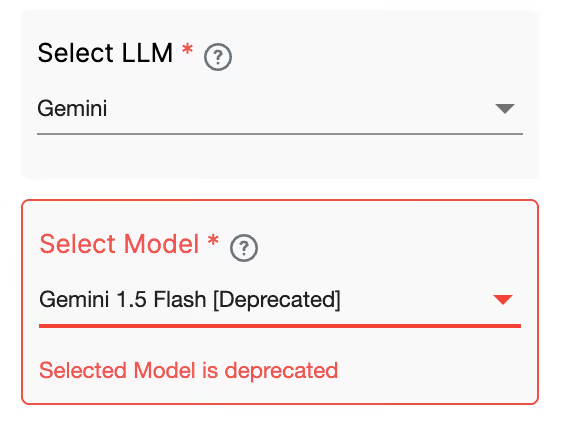
Deprecated models cannot be newly selected or saved when configuring the AI block. If an app was already configured using a deprecated model, the block will fail when it runs and return an error. In such cases, the admin must edit the block and switch to a supported model for the AI block to work again. This behaviour applies to Gemini as well as any other provider where models have been deprecated.
Description is positioned below the Input block which explains to the end user about the data that will be generated once they click on the AI button.
Description is positioned below the Input block which explains to the end user about the data that will be generated once they click on the Get Data from AI.
Description is an optional field.
NOTE - Since the Get Data from AI block is an Auto-Generated feature, it doesn’t require the user to enter any data into the block.
Configure the AI block by typing in the exact instructions to display the data that is needed.
For example, to fetch data from external sites, detect and display details in uploaded images or even perform calculations on uploaded files and images.
You can also use field variable names to make the AI analyse inputs from different app fields present.
Note: Tweak your instructions to get the required results before distributing the app to users.
The AI block can also process uploaded files such as PDFs and images.
PDF documents or images can be analysed for information extraction, summaries, or other tasks.
Note: When using Claude, the AI block can process up to 100 pages in a PDF document. Only document-type files are supported currently. Once additional formats are supported by the underlying models, they may be available here as well.
Support for file analysis depends on the selected LLM and model. While the AI block allows PDFs and images to be uploaded, some LLMs and specific models do not support image analysis, document analysis, or both.
When such a model is selected, this limitation is shown clearly in the configuration panel using a warning message displayed in yellow, specifying whether the selected model does not support images, documents, or both. In these cases, any unsupported files are ignored, and the AI block processes only the text instructions and referenced fields.
For example, certain Gemini models are text-only and do not support image or document analysis, some Grok models support image analysis but do not support document analysis, and all currently available Llama models are text-only and do not support file analysis.

Clappia AI (beta) supports text and image analysis. You can use it to analyse text entered in the app or images uploaded through blocks such as the Camera, Images & Files block.
Clappia AI does not support PDF or other document analysis. When a PDF or document field is referenced in the instructions, a warning is displayed in the configuration panel to indicate that document analysis is not supported. The document will not be analysed by Clappia AI.
Example 1: To calculate the total score in a checklist uploaded using the Camera, Images & Files block.
Blocks used: Camera, Images & Files block, Get Data from AI block.
Instructions: Check the scores in {upload_sc} under the score coloumn and calculate the total score. Display only the final value out of 100.
LLM: OpenAI
AI Model: gpt-4o


Example 2: Detect cleanliness of a room.
Blocks used: Camera, Images & Files block, Get Data from AI block.
Instructions: Check if the room in {upload_ima} is clean or not. Display only yes or no.
LLM: OpenAI
AI Model: gpt-4o


Example 3: Detect the distance traveled by a vehicle by checking the odometer.
In cases where the value is in between changing to the next increment, some OCR may not be able to detect it accurately. But the Get data from AI will be able to detect it accurately.
Blocks used: Camera, Images & Files block, Get Data from AI block.
Instructions: In {upload_ima}, check the trip distance traveled in the odometer and only display the distance. If it is about to change, display that distance instead.
LLM: OpenAI
AI Model: gpt-4o

Here, the distance, in the image, is about to change from 144.2km to 144.3km .

By default, the AI Block returns a single response based on your instruction. For example, if you ask the AI to extract details from an uploaded invoice, it can return all the extracted information, such as the date, name, phone number, address, tax, and amount, as a single output.
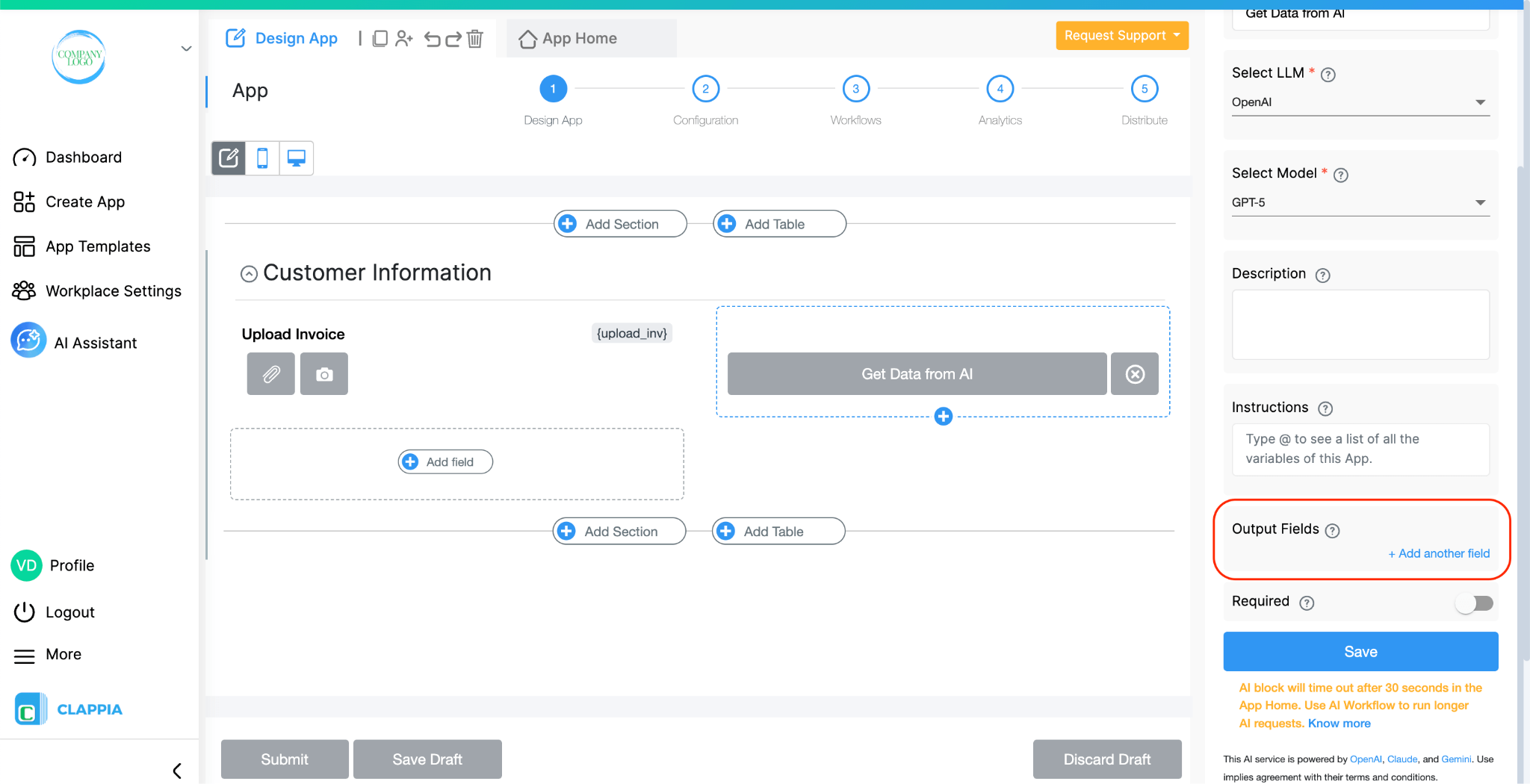
If you use multiple AI Blocks with different instructions to extract each value individually, this would consume additional AI credits.
With Output Fields, you can give the AI a single instruction and capture different parts of the response as separate outputs.
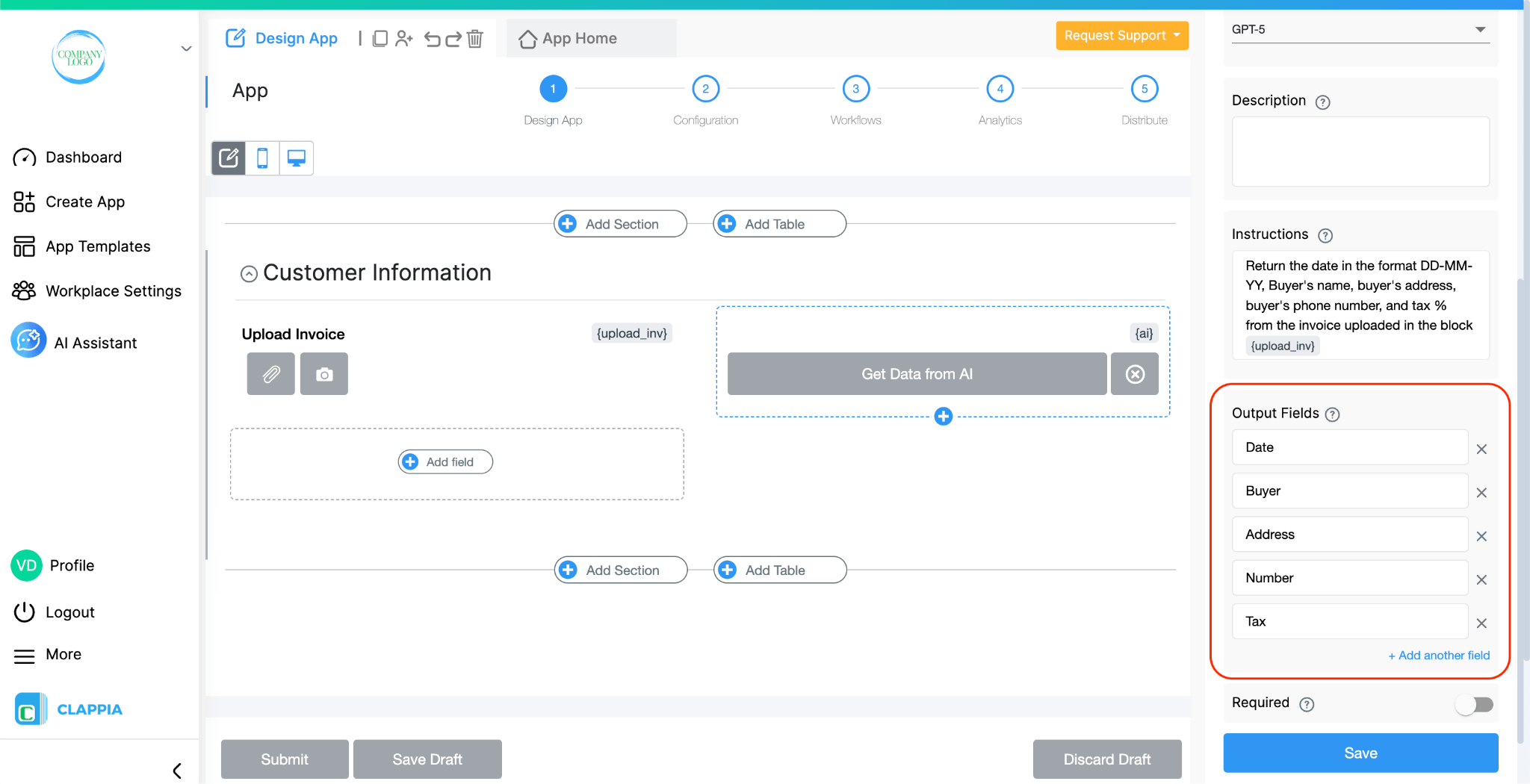
To add an output field, click Add Another Field. Enter the name of the information you want the AI to extract, such as Date, Name, Phone Number, Address, Tax, or Amount. Add as many output fields as required.
When you add output fields, the AI Block automatically creates a separate variable for each output field. These variables can be referenced in other blocks.
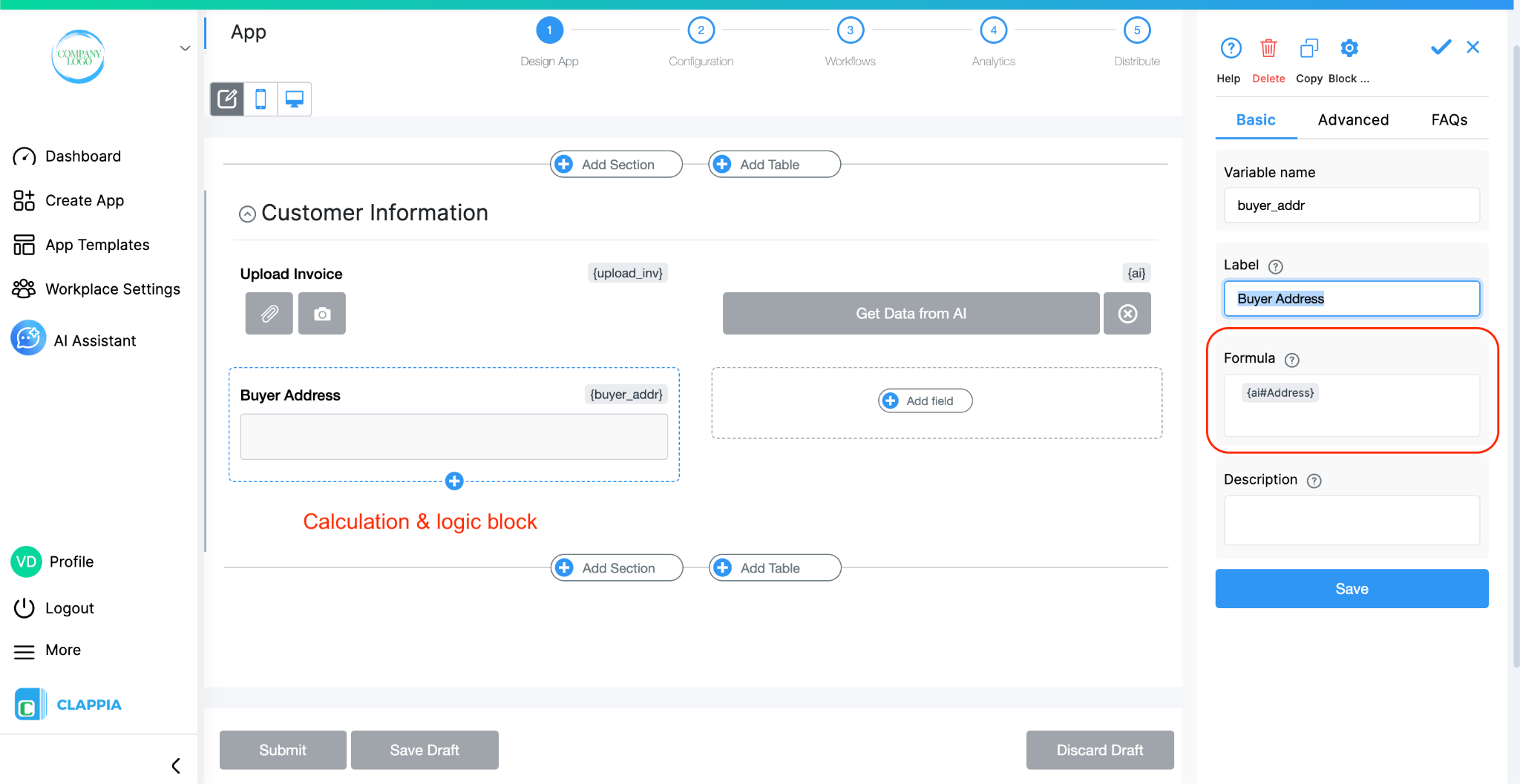
For example, if you want to display one of the extracted values, add a Calculation & logic block. In the block's right panel, enter @ followed by the AI Block name in the Formula field. You will then see all the output field variables with a #, which you can select and use in your formula.
Enable this option to tell the user that it is a compulsory field. Without generating the output of this block, users will not be able to make a submission if enabled.

The Advanced Label option allows you to change the label of a field dynamically based on a condition you define. Instead of always showing the same fixed label under the ‘Basic’ tab, the field can display different labels depending on requirements of the form. Use spreadsheet-like functions such as IF, AND, OR, etc. and make use of other field variables to set your conditions. Type @ and select the field.
This is useful when the meaning of a field changes based on context, business logic, or user choices.
For example, if you have a dropdown called AI Provider with options like “OpenAI” and “Claude”, you may want the label of your AI Block to change so that users clearly see which model or provider they are configuring.
So:
– If the user selects OpenAI, the label could change to: “OpenAI Prompt Settings”
– If the user selects Claude, the label could change to: “Claude Prompt Settings”
Formula:
This allows the same field to adapt its displayed purpose without needing multiple separate fields.
The Advanced Description option works exactly like Advanced Label, but it changes the description text instead. This is useful when guidance or instructions for a field need to change depending on earlier answers.
This helps users understand what is required from them without showing unnecessarily long or irrelevant instructions.
Additional Examples (Apply to Both Advanced Label and Advanced Description)
1. Showing nothing until a selection is made
For example, if you have a dropdown field called Visit Category with options “Routine” and “Urgent”, you may want the label or description of a field to remain blank until the user first selects a category.
Once a selection is made:
Formula (can be used in either Advanced Label or Advanced Description):
The label/description stays empty until the dropdown has a selected value.
After the user picks an option, the selected text (Routine or Urgent) becomes the label or description.
2. Changing label/description based on language selection
For example, if your form includes a dropdown field called Select Language with options English, Spanish, and French, you can show the label or description in the selected language.
So:
Formula (can be used in either Advanced Label or Advanced Description):
The formula returns the text for the selected language.
Only one label/description is shown at a time, depending on what the user picks in the Select Language dropdown.
1. Variables do not change
When a field is created, its variable name is derived from the label you set in the Basic tab. That variable name is what you must use in formulas, workflows, and other logic. The visible label or description shown by Advanced Label / Advanced Description does not change the variable name.
2. Submissions tab: table view vs right panel
In the Submissions area, the table view always displays the labels from the Basic tab. When you open an individual submission, the right panel shows the labels and descriptions as they appear in the form (i.e., the Advanced Label and Advanced Description applied for that submission). This keeps the submission list consistent while letting reviewers see the context-aware labels and descriptions when viewing a record.
3. Bulk Edit shows Basic tab labels and descriptions
When you need to Bulk Edit submissions, the spreadsheet you download shows the labels and descriptions from the Basic tab only. Advanced Label and Advanced Description are not applied in Bulk Edit, so keep that in mind when preparing bulk updates.
4. Some fields cannot be used inside Advanced Label/Description formulas
Certain block types do not expose a variable that can be referenced in Advanced Label or Advanced Description. If a block does not expose a variable, you cannot use it inside the formula.

Enable this option to show/hide the Get Data from AI block in relation with another Input block. It accepts the standard Clappia Formulae, similar to conditional sections.
Enable this to allow the field value to be changed after submission
Clappia provides two separate AI usage pools.
The existing AI usage limit is 100 calls per month, shared between the AI Block and AI Workflow Node. This limit applies when using supported AI providers such as OpenAI, Claude, Gemini, Mistral, Grok, and other available providers through Clappia.
Clappia AI (beta) has a separate usage limit of 5,000 calls per workplace per month. This limit is available to both free and paid workplaces.
Calls made using Clappia AI do not consume the existing 100 AI call limit. Similarly, calls made using other AI providers do not consume the 5,000 Clappia AI call limit.
Clappia AI usage is counted when it is successfully used through:
You can view your Clappia AI usage and the monthly 5,000-call limit from Workplace Settings > Billings. Your AI usage can also be seen in the Billings tab.
Workplace admins receive usage notifications when Clappia AI reaches:
Once the 5,000-call monthly limit is reached, further Clappia AI requests cannot be processed until additional usage is available. Other AI providers continue to use their own usage limits independently.
As an alternative, admins can use their own AI API key through Third-Party Integrations for supported providers.
Custom AI provider API keys cannot be used with Clappia AI (beta). Clappia AI uses Clappia's built-in AI service and is subject to its separate 5,000 calls per workplace per month usage limit.
If you already have your own API key for the AI provider you wish to use (such as OpenAI, Claude, Gemini, Mistral, or Grok), you can connect that key in Clappia and continue to use the AI workflow. This bypasses the usage limit in Clappia or the need for add-ons and you can continue to use the AI workflow.
To connect your own AI API key, open your app, go to Design App > Configurations > Third Party Integrations.
On the right panel, enter your API key for the selected AI provider and save.
Once connected, the AI Workflow Node will use your API key for processing requests.
When using your own API key:
This allows you to control AI usage limits and billing directly through your AI provider account.
Providing a custom API key is not supported for Llama models.
The Get Data from AI block has a 30-second execution limit. A timeout can occur when the AI takes too long to process the instructions and the data referenced in them.
Common reasons for this include:
If you encounter timeout errors:
When you select Clappia AI as the LLM, the data you provide to the AI Block, including instructions, field values, and images, is processed within Clappia-controlled infrastructure and is not sent to any external AI service providers. This data is not used to train AI models and is not retained by the model provider.
Unlike Clappia AI, if you select other LLMs such as OpenAI or Claude, the information you provide is subject to the respective providers' terms and conditions, similar to when you use their platforms directly.
Clappia does not access your customer data unless the necessary permissions or access have been granted.
Consider the type of data being processed and your organisation's data privacy requirements when choosing an AI provider for your workflows.
Note
This is a beta version of the AI service available as an optional add-on. It is not included in any plan.The block uses APIs to interact with external LLMs. Use of this feature implies agreement with the terms and conditions of the selected model provider.
L374, 1st Floor, 5th Main Rd, Sector 6, HSR Layout, Bengaluru, Karnataka 560102, India
3500 S DuPont Hwy, Dover,
Kent 19901, Delaware, USA


.svg)




3500 S DuPont Hwy, Dover,
Kent 19901, Delaware, USA
L374, 1st Floor, 5th Main Rd, Sector 6, HSR Layout, Bengaluru, Karnataka 560102, India