

Still need help?

This article explains the features of the Progress Bar block and how it can be configured to track the completion of fields in your app.

The Progress Bar visually represents the completion status of fields in the app. It dynamically updates based on the user’s inputs and helps provide clarity on how much of the form has been completed.

Click on the Progress Bar block and start editing on the panel that appears on the right side.


The label is the name of the block that the end user sees in the app.
Example: Progress, Form Completion, or Checklist Progress.
The Progress Formula defines how the progress is calculated based on the fields in your app.
You need to give a formula to calculate progress based on the completion of specific fields. Each field can contribute to the progress, and you can use a spreadsheet like formula to set how this is calculated.
Each field in the app that contributes to the progress, typically should have a numeric value associated with it.
For example, let’s say an app has two single selector fields and one multiline text field:
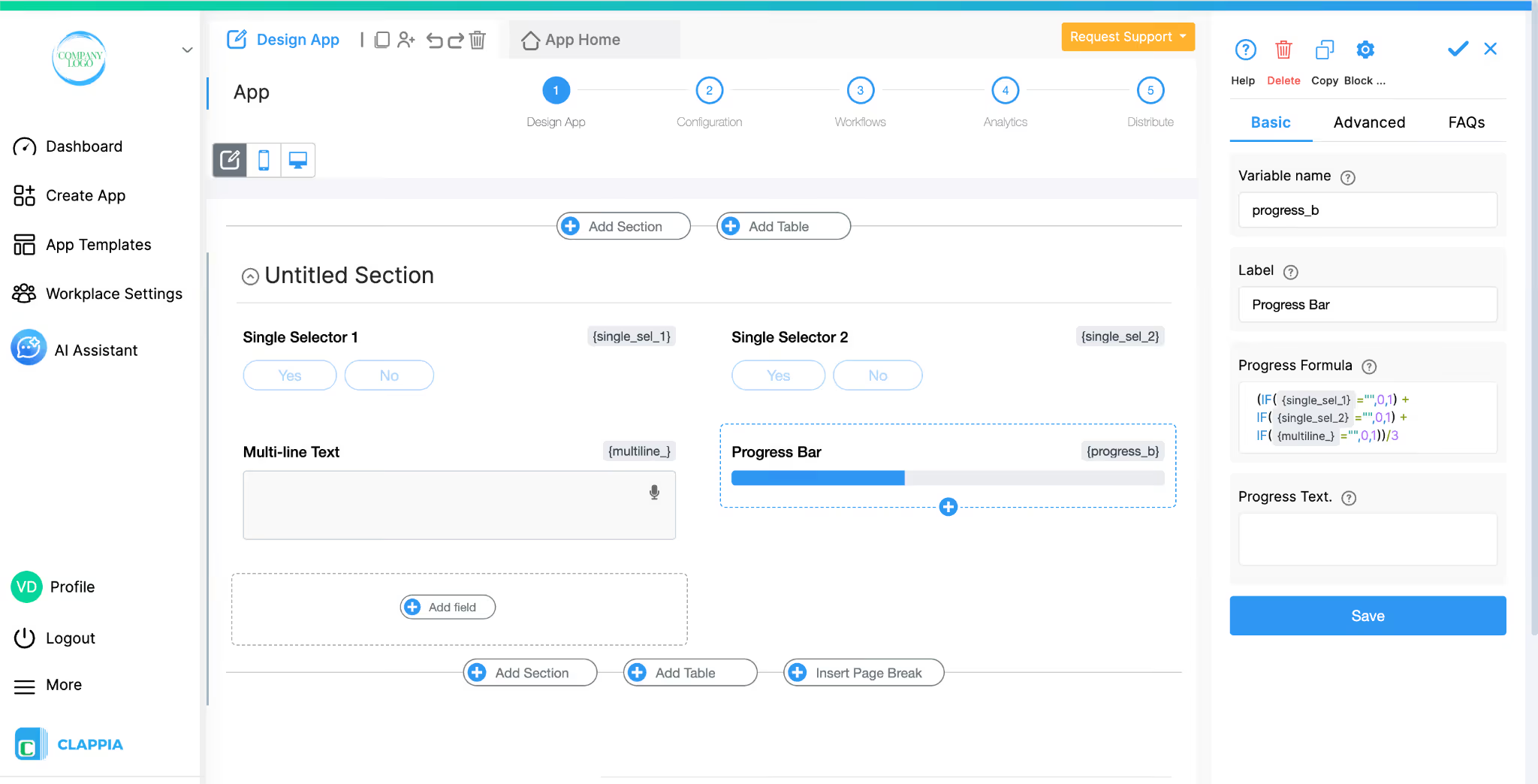
Use spreadsheet-like formulas to calculate progress:(IF({single_sel_1}="",0,1) + IF({single_sel_2}="",0,1) + IF({multiline}="",0,1))/3
You can type @ to pull up fields from your app. It will show up in brackets like {}.
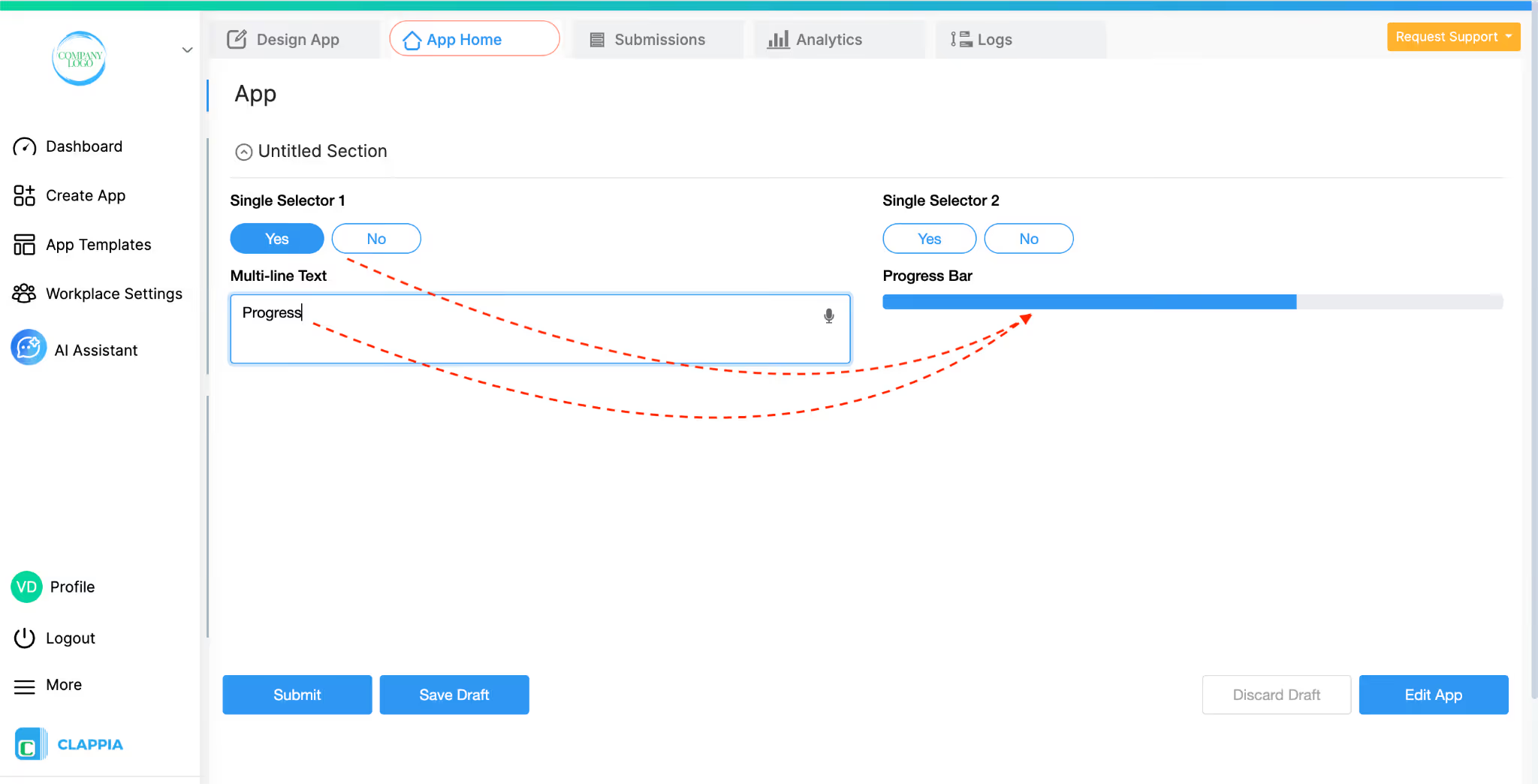
This formula adds up the completed fields and divides the total by the number of fields (in this case, 3) to calculate the total progress.
Key Points:
What does the formula do?
It checks whether a field is empty. If the field is empty, it assigns a value of 0; if the field is filled, it assigns a value of 1.
For example:
When the value is 1, the progress bar shows it visually, if 0 there is no change as you can see in the image above.
Why is this necessary?
The Progress Bar needs a formula to determine how much of the form is completed based on user inputs. You need to define how each field contributes to the progress, using field variables and conditions in the formula.
You can assign greater or lower values to certain fields depending on your requirements by making use of spreadsheet formulas.
You can configure the Progress Text to display a message below the progress bar.
This field does not accept formulas but allows dynamic text insertion using field variables.
Example: You have completed {progress_value} out of {total_value steps}.
See the detailed example later in this guide for a step-by-step explanation.

The Advanced Label option allows you to change the label of a field dynamically based on a condition you define. Instead of always showing the same fixed label under the ‘Basic’ tab, the field can display different labels depending on requirements of the form. Use spreadsheet-like functions such as IF, AND, OR, etc. and make use of other field variables to set your conditions. Type @ and select the field.
This is useful when the meaning of a field changes based on context, business logic, or user choices.
For example:
If you have a dropdown called Select with options “Onboarding Progress” and “Project Progress”.
The Label should reflect which progress is shown.
Formula:
IF({select} = "Onboarding Progress", "Onboarding Progress", "Project Progress")
This allows the same field to adapt its displayed purpose without needing multiple separate fields.
The Advanced Description option works exactly like Advanced Label, but it changes the description text instead. This is useful when guidance or instructions for a field need to change depending on earlier answers.
For example, using the same scenario from Advanced Label:
If you have a dropdown called Progress Context with options like “Onboarding” and “Project”, you may want the description of your Progress Bar field to guide the user differently depending on what they selected.
So:
– If the user selects Onboarding, the description could say: “Shows onboarding completion progress.”
– If the user selects Project, the description could say: “Shows project completion percentage.”
Formula:
IF({progress_context} = "Onboarding", "Shows onboarding completion progress.", "Shows project completion percentage.")
This helps users understand what is required from them without showing unnecessarily long or irrelevant instructions.
Additional Examples (Apply to Both Advanced Label and Advanced Description)
1. Showing nothing until a selection is made
For example, if you have a dropdown field called Visit Category with options “Routine” and “Urgent”, you may want the label or description of a field to remain blank until the user first selects a category.
Once a selection is made:
Formula (can be used in either Advanced Label or Advanced Description):
{visit_category}The label/description stays empty until the dropdown has a selected value.
After the user picks an option, the selected text (Routine or Urgent) becomes the label or description.
2. Changing label/description based on language selection
For example, if your form includes a dropdown field called Select Language with options English, Spanish, and French, you can show the label or description in the selected language.
So:
Formula (can be used in either Advanced Label or Advanced Description):
IF({select_language} = "English", "Enter details", IF({select_language} = "Spanish", "Ingrese detalles", "Entrez les détails"))The formula returns the text for the selected language.
Only one label/description is shown at a time, depending on what the user picks in the Select Language dropdown.
1. Variables do not change
When a field is created, its variable name is derived from the label you set in the Basic tab. That variable name is what you must use in formulas, workflows, and other logic. The visible label or description shown by Advanced Label / Advanced Description does not change the variable name.
2. Submissions tab: table view vs right panel
In the Submissions area, the table view always displays the labels from the Basic tab. When you open an individual submission, the right panel shows the labels and descriptions as they appear in the form (i.e., the Advanced Label and Advanced Description applied for that submission). This keeps the submission list consistent while letting reviewers see the context-aware labels and descriptions when viewing a record.
3. Bulk Edit shows Basic tab labels and descriptions
When you need to Bulk Edit submissions, the spreadsheet you download shows the labels and descriptions from the Basic tab only. Advanced Label and Advanced Description are not applied in Bulk Edit, so keep that in mind when preparing bulk updates.
4. Some fields cannot be used inside Advanced Label/Description formulas
Certain block types do not expose a variable that can be referenced in Advanced Label or Advanced Description. If a block does not expose a variable, you cannot use it inside the formula.
Geo Address
GPS Location
PaymentGateway
Audio
Live Tracking
Signature
Code Scanner
NFC Reader
Get Data from RestApi
Get Data from Other Apps
Get Data from Google Sheets
Get Data from Database
AI Block
Text, HTML & Embedding
Attached Files
Image Viewer
Video Viewer
PFD Viewer
Code block
Progress Bar
Action Button

Use this option to show or hide the field under specific conditions. It accepts the standard Clappia formulae, similar to conditional sections or in the ‘Calculations & Logic’ block.
Example: Show the Progress Bar only if a specific section is reached.
The Variable Name is the unique identifier for the Progress Bar block, automatically generated upon saving. This can be used in formulas or references within the app.
A Field Inspection Tracker app is created for safety inspections in a manufacturing plant. The app includes the following fields:
Field 1

Once the app is live, the Progress Bar dynamically updates as users fill in the form fields. For example:

If you'd like to display a custom progress description below the Progress Bar, such as "2 out of 3 completed," you can use the Progress Text option in the Progress Bar’s configuration panel. To dynamically calculate the values for progression, a Calculations & Logic block can be used.
Using the same example, the configurations are as follows:
‘Calculations & Logic’ Block:


Label: Progress Value
Formula: IF({has_the_eq}="",0,1) + IF({are_all_sa}="",0,1) + IF({actions_ta}="",0,1)
Variable (after saving): progress_v
Advanced option > Hidden: Enabled (This is to ensure that this field is not visible in the main app as it is not relevant for users to see).
Progress Bar:

Progress Text: {progress_v} out of 3 completed.
In App Home, it will look like the below image.

L374, 1st Floor, 5th Main Rd, Sector 6, HSR Layout, Bengaluru, Karnataka 560102, India
3500 S DuPont Hwy, Dover,
Kent 19901, Delaware, USA


.svg)




3500 S DuPont Hwy, Dover,
Kent 19901, Delaware, USA
L374, 1st Floor, 5th Main Rd, Sector 6, HSR Layout, Bengaluru, Karnataka 560102, India