

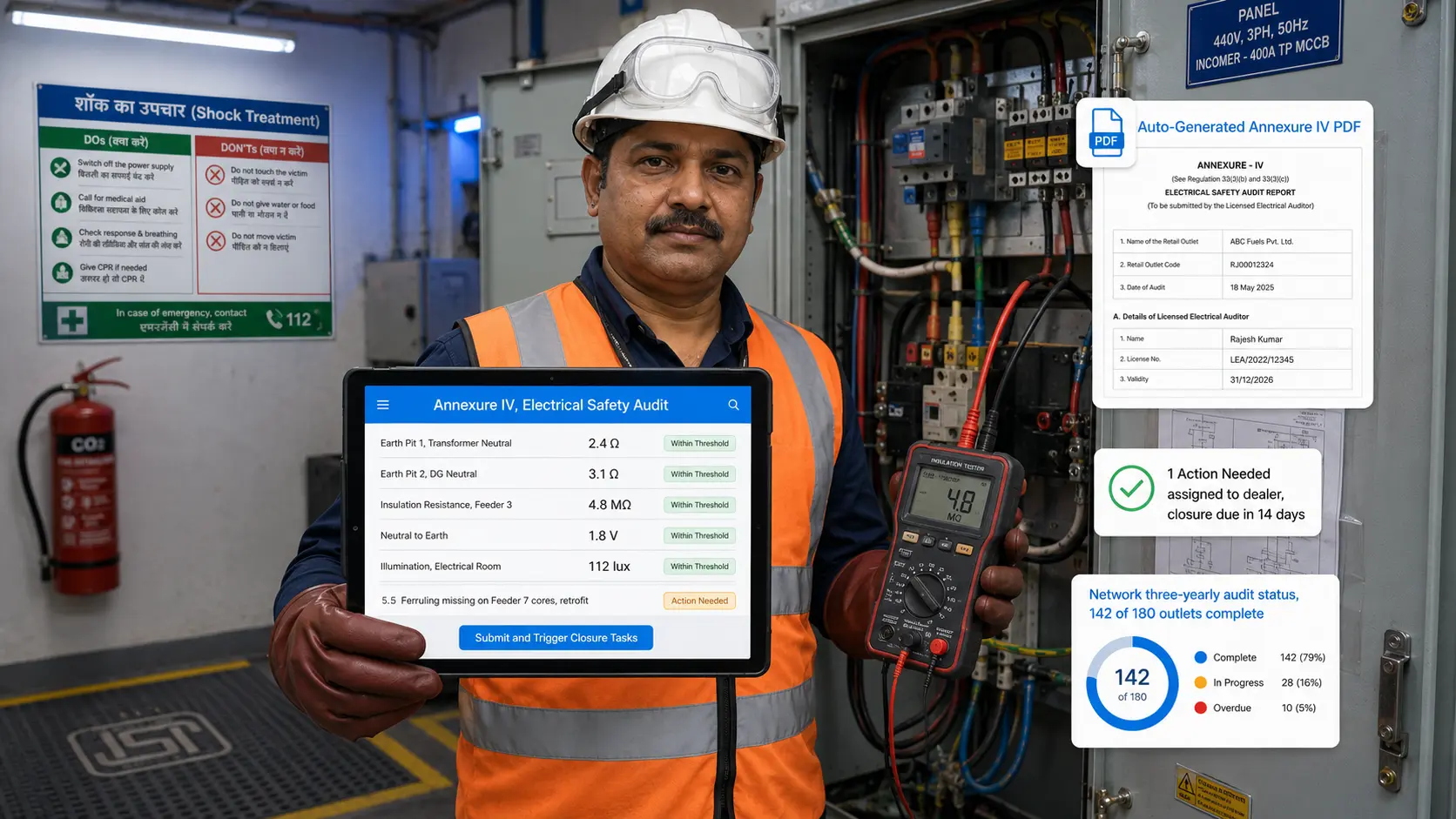
PNGRB mandates a three-yearly electrical safety audit at every petroleum retail outlet, conducted by a licensed electrical agency or a company-authorised person, against the format prescribed in Schedule 1, Annexure IV of the T4S Regulations. The audit covers six categories with around twenty sub-items, each with specific thresholds. Miss one, and the dispenser, electrical room, or the entire outlet can be flagged unsafe. This article walks through every category, what auditors test for, the threshold values you need to know, and how a Clappia PNGRB audit checklist app turns the audit into a structured digital exercise with traceable closure. For the wider checklist stack, see the parent PNGRB audit checklist guide.
Annexure IV, titled "System Document for Electrical Safety Audit", sits inside Schedule 1 of the PNGRB Technical Standards and Specifications including Safety Standards (T4S) Regulations, which govern every retail outlet dispensing MS, HSD, Auto LPG, CNG, LNG, and LCNG in India.
The audit is structured into six categories. A: Deviation from laid-down procedure (statutory requirements under Indian Electricity Rules, Petroleum Rules, OISD standards). B: Insulation, Grounding and Lightning Protection (IS 3043 and IS 2309). C: Protection and Metering System (under-voltage, over-voltage, phase imbalance, emergency push button). D: Loose connection and overheating (cable terminations, equipment overload). E: Safety (rubber mat, CO2 extinguisher, shock treatment chart, work permits, labelling). F: Repair and Maintenance (panel dust, spare holes, drawings).
Each item has two columns in the regulatory format: "Observation" and "Action Needed". The auditor fills in both, which means every audit is also a corrective action list.
Three years is a long gap. Between two Annexure IV audits, a slow drift can build silently. Insulation resistance degrades from monsoon humidity entering panel boxes that lost their gasket seal. Earth pit resistance creeps up as salt and water in the earthing chamber dry out. A flameproof terminal box on a dispenser loses two bolts, breaking its Ex d certification. A sub-standard component gets installed during an emergency repair and never gets replaced.
The annual Annexure V safety audit catches some of this. The weekly Annexure III check catches almost none of it because it is a visual inspection, not a measurement audit. The three-yearly Annexure IV is the only routine where someone with a megger, multimeter, and earth tester physically tests the values that keep the outlet safe. PNGRB additionally requires the earth resistance specifically to be checked at least once a year, so Annexure IV is three-yearly with an annual earth resistance interim test.
The full list, organised by category, with what the auditor records and the action that gets triggered when a deviation is found.
| Category | Item | What it checks | Typical Action Needed |
|---|---|---|---|
| A. Statutory deviations | 1.1 Enclosure mismatch with zone | Hazardous area Zone 0/1/2 vs equipment Ex d, Ex e, Ex i, Ex n | Install equipment with the correct enclosure type |
| 1.2 Clearances not maintained | Spacing in front of, behind, and beside the PDP and panels | Restore minimum clearance per regulation | |
| 1.3 Material not per IS | Cables, glands, fittings against IS 5571 and IS 5572 | Replace with IS-approved materials | |
| 1.4 Inappropriate illumination | Lux levels under canopy, electrical room, customer care | Modify lighting to meet the recommendation | |
| B. Insulation, grounding, lightning | 2.1 Equipment not earthed | Earth connection on every electrical equipment | Provide earth connection per recommendation |
| 2.2 Transformer / DG neutral not earthed | Neutral points of transformer and DG set | Ground neutral points | |
| 2.3 Lightning / surge arrestors | In place, properly placed, connected to earth | Install and connect arrestor | |
| 2.4 High earth resistance | Earth pit resistance reading | Add salt and water to earth pit, reduce resistance | |
| 2.5 Insulation resistance low | Megger reading per feeder, must be above 1 Mega Ohm | Repair damaged insulation, restore reading | |
| 2.6 Panel doors not earthed | Flexible braided connection on every panel door | Install missing flexible earth links | |
| 2.7 Electrical room not clean | Water accumulation in room and cable trenches | Clean room, wipe water, block water entry holes | |
| C. Protection and metering | 3.1 Emergency push button jammed | Mushroom-type red push button operation | Replace push button, test by simulation |
| 3.2 Under / over voltage, phase unbalance | Relay set point and simulation | Set relay, simulate fault to verify | |
| 3.3 Neutral snap, phase failure | Protection relay operation | Same as 3.2 | |
| 3.4 Meters not recording | kWh meter, voltmeter, ammeter | Replace meter and its CT/PT | |
| D. Loose connection, overheating | 4.1 Loose cable terminations | Tightness at every termination | Tighten termination properly |
| 4.2 Equipment overload | Heating, burning smell, load vs design | Restrict load within design limit | |
| E. Safety | 5.1 Lighting fixtures non-functioning | Lights near dispenser, tank farm, sales room, electrical room | Check and rectify lighting circuits |
| 5.2 Safety equipment missing | Rubber mat, CO2 extinguisher, shock treatment chart, flameproof torch | Place at designated locations, train staff | |
| 5.3 Work without permit | Repair work being done without authorised work permit | Implement work authorisation procedure | |
| 5.4 Sub-standard components | Quality of components in use | Use standard good-quality components | |
| 5.5 Labels / ferruling missing | Tag-marks on equipment, cables, feeders, cores | Put missing labels / ferrules per drawing | |
| 5.6 Drawings not in panels | Single-line diagrams in dedicated panel pockets | Keep drawings in panel pockets | |
| F. Repair and maintenance | 6.1 Dirt and dust in panel | Panel interior condition | Clean periodically |
| 6.2 Spare holes in panel | Open / unblocked gland plate holes | Block spare holes |
These are the numbers an auditor measures with instruments and writes against each item. Memorise these; they are the difference between "Pass" and "Action Needed".
| Parameter | Threshold | Where it applies |
|---|---|---|
| Insulation resistance | Above 1 Mega Ohm | Every feeder, every motor circuit |
| Neutral-to-earth voltage | Limited to 3V | At the PDP and at major load points |
| Earth pit resistance | As low as practicable, trended cycle over cycle | Every earth pit (transformer neutral, DG neutral, equipment, instrument, lightning) |
| Illumination, approach area | 50 lux | Entrance and exit drives |
| Illumination, under canopy | 150 lux | Forecourt under canopy |
| Illumination, customer care room | 100 lux | Sales building |
| Illumination, electrical / compressor area | 100 lux | Electrical room, compressor area |
| Number of earth pits per equipment | 2 (for above 400V, 3-phase) | Transformer, DG set, major motors |
| Earthing for equipment up to 230V, 1-phase | At least 1 point | Single-phase equipment enclosures |
The regulation is specific. The audit must be conducted by a licensed electrical agency (with statutory licence valid in the state where the outlet sits), or a company-authorised person with the technical competence to operate and interpret electrical testing instruments (megger, earth tester, multimeter, clamp meter).
The audit team typically includes someone with hands-on hazardous area knowledge because items in category A (zone-equipment match) require interpreting the outlet's hazardous area classification drawing alongside the actual equipment installed. A dealer's electrician cannot conduct this audit. The DSM who runs the weekly Annexure III check certainly cannot.
If you are moving the electrical audit off paper, the form needs to capture every regulatory field and several that make the data trendable over the next three-year cycle.
For identity and context: outlet code, address, dealer name, marketing company (pulled from the master list), auditor name with licence number and agency name, audit date with start and end time, GPS coordinates of submission, date of previous Annexure IV audit (for the three-yearly cadence check).
For per-item readings and observations: free-text Observation field for each sub-item, free-text Action Needed field for each (mandatory if observation is non-conforming), numeric fields with validation for earth pit resistance in ohms, insulation resistance per feeder in mega ohms, neutral-to-earth voltage in volts, illumination per area in lux, continuity readings. Conditional photo upload that becomes mandatory when Action Needed is filled. Severity tag (Critical / Major / Minor) per non-conformity.
For evidence and sign-off: photos of each earth pit with the megger reading visible, photos of every panel interior showing cable termination, ferruling, and dust condition, photos of safety equipment in the electrical room (rubber mat, CO2 extinguisher, shock treatment chart, flameproof torch), auditor digital signature, dealer counter-signature, marketing company representative signature where applicable.
For computed fields: total non-conformities per category and overall, count of Critical / Major / Minor items, days remaining to next due Annexure IV, sequential audit ID.
The Clappia PNGRB audit checklist app covers each of these fields with a specific block.
| Annexure IV need | Clappia feature |
|---|---|
| Scan each panel, earth pit, transformer, and DG set before logging readings | QR code and barcode scanner for asset-level traceability across the cycle |
| Capture earth pit resistance, insulation resistance, and voltage readings with validation | Number input fields with min/max validation against PNGRB thresholds |
| Prove the licensed agency representative was physically at the outlet | GPS location block auto-captures coordinates on form open |
| Auditor and dealer sign-off, plus marketing company representative where required | Digital signature blocks, one per signatory |
| Mandatory photo on every "Action Needed" entry | Camera and file upload block triggered by conditional logic |
| Auto-generated PDF in the Annexure IV format with embedded readings and photos | Print Settings templates that mirror the regulatory layout |
| Route every "Action Needed" item to the right approver for closure | Approval workflows with dealer, regional engineer, and HSE lead |
| Alert on Critical findings (push button jammed, insulation low, voltage above 3V) | WhatsApp, Slack, email, and SMS workflow nodes |
| Track audit due dates across the three-year cycle, plus annual earth resistance interim checks | Live dashboards with filters by outlet, region, and category |
| Run the audit at outlets with poor connectivity | Offline mode by default on Android and iOS |
| Field-only mobile UX for the auditor | Clappia mobile app for tablet and phone |
Build your electrical audit app on Clappia in minutes, capture every reading, photo, and signature.
Get Started For FreeThe "Action Needed" column is the whole point of Annexure IV. Without closure tracking, the audit produces a list that nobody acts on.
A working setup. Zero deviations: auto-generated PDF in the Annexure IV format is emailed to the dealer, the area manager, and the company HSE lead, and the next Annexure IV due date is auto-set for three years from this submission. Minor deviation (ferruling missing on cables, dust accumulation inside a panel): a WhatsApp message goes to the dealer with the PDF and the action item, and the dealer gets 14 days to mark it closed with a closure photo. Major deviation (earth resistance high, panel doors not earthed, insulation below 1 Mega Ohm): an approval workflow routes the corrective action plan to the regional electrical engineer, and the dispenser or affected feeder is flagged restricted until closure is signed off. Critical deviation (emergency push button jammed, flameproof equipment compromised, voltage to ground exceeded): immediate WhatsApp call-out to the area manager and HSE lead, and the relevant facility is shut down until certified safe by the company-authorised person.
Every closure gets a closure photo, a closure date, and a closure signature. The audit's completion is not "submitted", it is "every Action Needed closed".
A regional electrical engineer at an oil marketing company oversees the three-yearly Annexure IV audit cycle across 180 retail outlets in a state. Before going digital, the licensed agency would submit a paper report per outlet. Each report had to be manually transcribed into a spreadsheet for trend analysis. About 15 to 20 percent of "Action Needed" items got lost in email threads between the dealer, the agency, and the area office.
After moving to the Clappia template, the auditor fills the digital Annexure IV on-site from a tablet, captures instrument readings directly into validated number fields, and photographs every panel interior. The submission auto-generates the PDF in the Annexure IV format with embedded readings, photos, and the auditor's signature. Every "Action Needed" item creates an automatic corrective action task assigned to the dealer with a deadline. The regional engineer sees a live dashboard showing audits due in the next 90 days, audits completed, open corrective actions per outlet, and the network-wide pattern across categories. The pattern that emerged in the first cycle: 60 percent of outlets had at least one panel door missing the flexible braided earth connection. The fix went out as a network-wide retrofit, and the next cycle showed near-zero recurrence.
The three-yearly electrical audit is the deepest electrical-specific check, but it is one of several. Use it alongside the PNGRB Annexure III weekly inspection checklist, which includes a visual check on electrical loose connections every seven days; the PNGRB Annexure V annual safety audit checklist, which covers electrical items as one section of the broader yearly audit; the PNGRB Annexure VI(a) operator work permit, required for electrical switchboard work below hazardous area; the PNGRB Annexure VI(b) hot work permit, required for any non-routine electrical work inside a hazardous area; and the parent PNGRB checklist guide.
Once every three years, by a licensed electrical agency or a company-authorised person. Separately, the earth resistance specifically must be checked at least once a year. The annual Annexure V safety audit also covers electrical items as one of its sections, but it is not a substitute for Annexure IV.
Per Annexure IV, the insulation resistance for any feeder must be above 1 Mega Ohm. If it falls below, the damaged portion of insulation must be repaired and the value brought back above 1 Mega Ohm before the audit can pass that line item.
The voltage between neutral and earth must be limited to 3V. A reading above 3V is logged as an observation with "Action Needed", and the corrective action is typically rebalancing loads, fixing the neutral connection at the transformer, or improving the earthing.
Yes. Annexure IV item 5.2 lists rubber mat, CO2 fire extinguisher, shock treatment chart, and flameproof torch as safety equipment that must be in their designated places. The rubber mat must carry the ISI mark. A missing rubber mat triggers an "Action Needed" entry.
This is contractual between the dealer and the oil marketing company. In most networks, the marketing company empanels licensed electrical agencies, schedules audits across the territory, and bears the audit cost. The dealer bears the cost of any rectification work flagged in the "Action Needed" column.
Item 2.6 requires every panel door to be earthed with a flexible braided connection. Missing braids must be put back at the earliest. This is one of the most commonly flagged items across Indian retail outlets and is the easiest to fix.
The electrical audit is the most technically demanding routine in the PNGRB stack, and the one with the longest gap between cycles. That makes it the most important place to capture readings cleanly, trend them across cycles, and chase every "Action Needed" item to closure. A paper audit report is too easy to file and forget. A digital one keeps surfacing the open items on the dashboard until they get closed.
Ready to run Annexure IV with traceable closure? Sign up for free and build your electrical audit app on Clappia in under 10 minutes. No credit card, no contracts, no risk, just results.
 Get Started – It’s Free
L374, 1st Floor, 5th Main Rd, Sector 6, HSR Layout, Bengaluru, Karnataka 560102, India
3500 S DuPont Hwy, Dover,
Kent 19901, Delaware, USA


.svg)




3500 S DuPont Hwy, Dover,
Kent 19901, Delaware, USA
L374, 1st Floor, 5th Main Rd, Sector 6, HSR Layout, Bengaluru, Karnataka 560102, India