

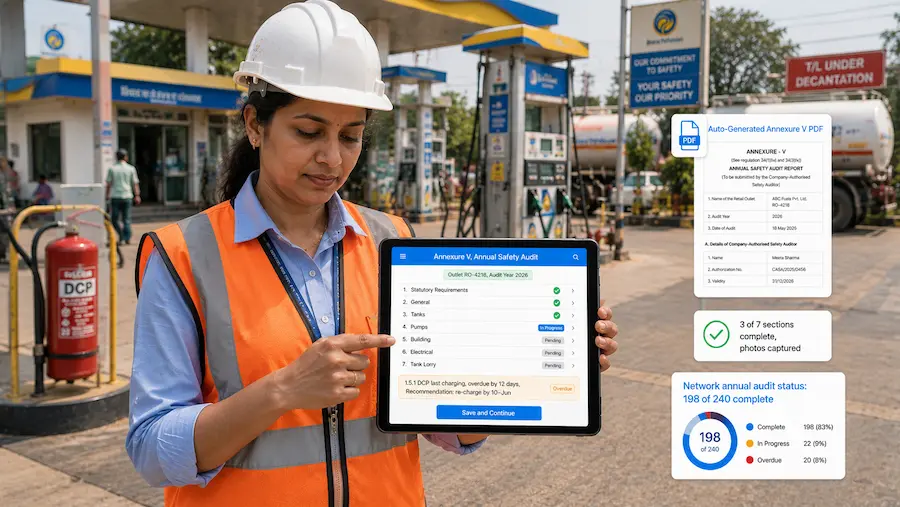
PNGRB mandates a comprehensive annual safety audit at every petroleum retail outlet, conducted by a company-authorised person or empanelled agency, against the format prescribed in Schedule 1, Annexure V of the T4S Regulations. The audit runs through seven sections covering statutory licences, tanks, pumps, building services, electrical, and tank lorry operations, with around 50 line items in total. This article walks through every section, what auditors record under Observation and Recommendation, and how a Clappia PNGRB audit checklist app turns the audit into a structured digital exercise with traceable closure. For the wider checklist stack, see the parent PNGRB audit checklist guide.
Annexure V, titled "Safety Audit Checklist", sits inside Schedule 1 of the PNGRB Technical Standards and Specifications including Safety Standards (T4S) Regulations, which govern every retail outlet dispensing MS, HSD, Auto LPG, CNG, LNG, and LCNG in India.
The audit is organised into seven sections. Section 1: Statutory Requirements covers CCOE licence, drawing, safety messages, explosives rules, fire extinguishers, fire buckets, and W&M verification. Section 2: General covers housekeeping. Section 3: Tanks covers dip rod, fill pipe, vent pipe, manhole chamber, curb walls, lorry discharge, and bonding. Section 4: Pumps covers dispenser condition, motor earthing, loose wiring, flameproof boxes, and sand below pedestal. Section 5: Building and other facilities covers generator room storage and ventilation. Section 6: Electrical covers the full electrical scope from wiring to insulation and the shock treatment chart. Section 7: Tank Lorry covers the lorry-side checks during decantation.
Each line item has three columns: Sl. No., Observation (what the auditor saw), and Recommendation (what should be done). The Recommendation column is the corrective action list for the next year.
A year is a long window. The weekly Annexure III check catches obvious housekeeping and the things a DSM can spot. The three-yearly Annexure IV electrical audit catches measured electrical issues. Annexure V is the only routine that runs through the full statutory paperwork, the tank-side fittings, the generator room contents, and the tank lorry decantation practice in one sweep, every year.
What drifts in 12 months. The CCOE licence renewal date slips through the cracks if no calendar is watching it. The W&M last-verification date crosses one year and the dispenser is technically out of legal compliance for sale. A flameproof box on a dispenser loses a bolt during a maintenance call and never gets closed properly. Sand under a dispenser pedestal mixes with seepage and turns into a fire risk. A new generator room gets stacked with cardboard cartons because nobody told the staff it was a no-flammables zone. None of these get flagged by the weekly check.
The annual audit is the safety net.
The full structure, organised by section, with what auditors record.
| Section | Item ref. | Audit item | What auditors look for |
|---|---|---|---|
| 1. Statutory Requirements | 1.1 | CCOE Licence and Drawing available | Original licence on file, valid date |
| 1.1.1 | Validity and date of renewal | Renewal initiated 90 days before expiry | |
| 1.2 | Drawing reflects existing facilities | Approved drawing matches what's on the ground today | |
| 1.3 | Safety messages displayed | Fire, Police, Hospital tel. nos., No Smoking, T/L under decantation, Explosive licence no. | |
| 1.4 | Extract of Explosives Rules exhibited | Posted in a visible location | |
| 1.5 / 1.5.1 | DCP 10 Kg fire extinguishers per outlet/pump, last date of charging | One DCP per dispenser, charging within validity | |
| 1.6 | Fire buckets, 9 ltr round bottom, dry sand, with cover | Max 10 numbers, sand dry, lid in place | |
| 1.7 | Last date of W&M verifications | Within one year, dispenser stamps valid | |
| 2. General | 2.1 | Good housekeeping | Dustbins, garbage disposal, cotton waste disposal, drainage cleaning |
| 3. Tanks | 3.1 | Dip rod floating? | Should not float in the tank, suggests product issue |
| 3.2 | Fill pipe threads at 75 mm standard size | Matches tank lorry hose connection | |
| 3.3 | Vent pipe located per approved drawing | Position and height as per PESO approval | |
| 3.4 | Wire gauge of vent cap (missing, clogged) | Two layers, not less than 11 meshes per sq cm | |
| 3.5 | Manhole chamber free of rubbish and oil spillage | No cotton waste, no rags, no seepage | |
| 3.6 | Tank curb walls / pipe railings in good condition | No cracks, no missing rails | |
| 3.7 | Lorry discharge points distinctively painted per standard | Per OMC colour scheme for the product | |
| 3.8 | Lorry discharge points and dip pipe securely closed | Caps locked, key under custody | |
| 3.9 | Sand buckets and fire extinguishers positioned near T/L during unloading | Available before unloading starts | |
| 3.10 | Bonding wire connected while decanting | Earth continuity confirmed | |
| 4. Pumps | 4.1 | Pumps clean, not leaky | No fuel stains, no seepage at base |
| 4.2 | Electric motors properly earthed, located per drawing, easily accessible | Two earth points for motors above 400V, accessible for service | |
| 4.3 | No loose wiring in the pump | Cable glands tight, junction boxes closed | |
| 4.4 | Flameproof boxes closed properly | All bolts in place, Ex d certification intact | |
| 4.5 | Dry sand filled in gap below pump pedestal | Sand pourable, not clumped, not contaminated | |
| 5. Building and other facilities | 5.1 | No flammable materials (LPG cylinders, cardboard) in generator room | Generator room reserved for genset only |
| 5.2 | Generator room ventilated, clean, dry | Cross ventilation for heat extraction | |
| 6. Electrical | 6.1 | Electrical system per standard | As per Annexure IV requirements |
| 6.2 | No loose wiring in switch board | All terminations tight | |
| 6.3 | Earthing per new standards (IS 3043) | Earth pit count and connection per regulation | |
| 6.4 | Light fixtures in good condition | No dead bulbs, no flickering, FLP rating intact | |
| 6.5 | Cables with FLP glands fitted to pumps | Flameproof glands, certified type | |
| 6.6 | All equipment labelled | Tag-marks per drawing | |
| 6.7 | Cable / wire terminations tightened | Torque check at critical points | |
| 6.8 | No dirt or dust inside electrical panels | Clean panel interiors | |
| 6.9 | Spare cable entry holes blocked | No open holes in gland plates | |
| 6.10 | Panel doors earthed with flexible braided connection | Braided earth link on every door | |
| 6.11 | Electrical equipment earthed per recommendations | Per IS 3043 standard | |
| 6.12 | Neutral point of transformer and DG set earthed | Two earth pits each | |
| 6.13 | Lightning / surge arrestors in place and working, connected to earth | Per IS 2309, periodic test | |
| 6.14 | Insulation resistance of each feeder more than 1 Mega Ohm | Megger reading per feeder | |
| 6.15 | Voltage between neutral and earth limited to 3V | Multimeter reading at PDP | |
| 6.16 | Electrical room clean, free from water accumulation | No water in cable trenches | |
| 6.17 | No undue heating in any equipment | Thermal scan, smell test | |
| 6.18 | Shock treatment chart in electrical room, persons trained | Bilingual chart, training records on file | |
| 7. Tank Lorry | 7.1 | Earth wire connected properly during decantation | Bonding to fixed earth before unloading |
| 7.2 | Fire extinguisher available on the lorry | 9 kg DCP on the truck | |
| 7.3 | Fire extinguisher kept accessible | Within reach during unloading | |
| 7.4 | PCVO crew aware of fire fighting methods | Verbal check or recent training cert | |
| 7.5 | Dip pipe kept closed while decanting | No vapour escape |
The regulation specifies a company-authorised person or agency. In practice, oil marketing companies (IOCL, BPCL, HPCL, Reliance, Nayara, Shell) empanel a pool of qualified safety auditors and rotate them across territories so the same auditor is not visiting the same outlet year on year. The auditor must have the technical competence to read CCOE drawings, interpret electrical readings, evaluate flameproof equipment, and run the tank lorry decantation observation.
A dealer's electrician cannot run this. A DSM cannot run this. The auditor is typically a qualified mechanical or electrical engineer with hazardous area certification and audit training.
Identity and context fields: outlet code, address, dealer name, marketing company (pulled from the master list), auditor name with employee ID and agency name, audit date with start and end time, GPS coordinates of submission, date of previous Annexure V audit (for the annual cadence check), reference number of the CCOE licence on file, reference number of the approved CCOE drawing.
Per-item Observation and Recommendation fields: free-text Observation field for each of approximately 50 sub-items, free-text Recommendation field for each (mandatory if observation is non-conforming), numeric fields for insulation resistance per feeder in mega ohms, neutral-to-earth voltage in volts, count of fire extinguishers, count of fire buckets. Conditional photo upload that becomes mandatory when a Recommendation is filled.
Validity-tracking fields: CCOE licence expiry date, next CCOE licence renewal trigger date, W&M last verification date, DCP fire extinguisher last charging date per extinguisher (linked to QR-tagged extinguisher), next charging due date, training records date for shock treatment.
Evidence and sign-off fields: photos of the CCOE licence on display, photos of the approved CCOE drawing alongside current installation for comparison, photos of every dispenser flameproof box, photos of the generator room interior, photos of the electrical panel interiors and panel doors with braided earth, auditor digital signature, dealer counter-signature.
Computed and workflow fields: total non-conformities per section and overall, severity tag (Critical / Major / Minor) per non-conformity, sequential audit ID, next due date for the annual cycle.
| Annexure V need | Clappia feature |
|---|---|
| Scan each dispenser, tank, fire extinguisher, panel, and generator before logging the audit | QR code and barcode scanner auto-fills asset ID, last service date, next due date |
| Track CCOE licence expiry, W&M verification, and extinguisher charging due dates | Date selector blocks plus formula block to compute days remaining, with workflow reminders |
| Capture insulation resistance, neutral-earth voltage, and other readings with validation | Number input fields with min/max thresholds set against PNGRB requirements |
| Prove the company-authorised person was physically at the outlet | GPS location block auto-captures coordinates on form open |
| Auditor and dealer sign-off on the closing meeting | Digital signature blocks for both parties |
| Photo evidence of the CCOE licence, drawing vs reality, flameproof boxes, panels | Camera and file upload block triggered by conditional logic |
| Auto-generated PDF in the Annexure V format with all 50+ items, embedded photos and signatures | Print Settings templates that mirror the regulatory layout |
| Route every Recommendation to the right approver, with closure tracking | Approval workflows with dealer, regional engineer, HSE lead |
| Alert on Critical findings (CCOE expired, W&M lapsed, fire equipment unfit) | WhatsApp, Slack, email, SMS workflow nodes |
| Network compliance dashboard for the annual cycle across all outlets | Live dashboards with filters by outlet, region, section, severity |
| Pre-populate Annexure V draft from the year's weekly Annexure III observations | Get Data from Other Apps block, pulls non-conformities from the weekly app into the annual draft |
| Run the audit at outlets with poor connectivity | Offline mode by default on Android and iOS |
| Field-only mobile UX for the auditor | Clappia mobile app for tablet and phone |
Build your annual safety audit app on Clappia in minutes, with photo evidence and closure tracking.
Get Started For FreeThe Recommendation column is the corrective action list for the next 12 months. Without a system to chase closure, the same Recommendations show up again at the next audit.
Zero non-conformities: the auto-generated PDF in the Annexure V format goes to the dealer, area manager, and HSE lead, and the next Annexure V due date auto-sets for 12 months out. Minor non-conformity (housekeeping in generator room, missing label, dustbin overflow): a WhatsApp message goes to the dealer with the action item and a 14-day closure target. Major non-conformity (CCOE drawing does not match reality, W&M overdue, vent cap wire gauge clogged or missing): an approval workflow routes the corrective action plan to the regional engineer, with restrictions noted for the affected facility. Critical non-conformity (CCOE licence expired, fire extinguishers unfit, electrical panel doors not earthed): immediate WhatsApp call-out to the area manager and HSE lead, with the option to shut down the affected facility until certified safe.
Every closure produces a closure photo, a closure date, and a closure signature, against a target date set at the time of audit.
A network HSE compliance lead at an oil marketing company runs the Annexure V annual audit cycle across 240 retail outlets in two states. Before going digital, the empanelled auditors filled paper reports per outlet. About 25 percent of Recommendations were still open when the next annual cycle started, because the closure tracking sat in three different inboxes between the auditor, the dealer, and the area office.
After moving to the Clappia template, the auditor fills the digital Annexure V on-site from a tablet, captures photos of every CCOE licence, drawing, dispenser flameproof box, and electrical panel, and the submission auto-generates the regulatory-format PDF. The 50+ Recommendations become 50+ corrective action tasks, each with an owner and a deadline. The HSE lead sees a live dashboard showing audits due in the next 90 days, audits completed, open Recommendations per outlet, and the network-wide pattern across sections. In the second cycle, the pattern of repeat findings dropped by 70 percent because every Recommendation from the first cycle had a tracked closure date.
The annual safety audit is the broadest annual check, sitting between the weekly Annexure III and the three-yearly Annexure IV. Use it alongside the PNGRB Annexure III weekly inspection checklist, whose 12 months of weekly observations should pre-populate the Annexure V draft; the PNGRB Annexure IV electrical audit checklist, whose readings inform Section 6 of the annual audit; the PNGRB Annexure VI(a) operator work permit for any non-routine work, the PNGRB Annexure VI(b) hot work permit, and the PNGRB Annexure VII tank-truck decantation checklist, which Section 7 of the annual audit reviews. The parent PNGRB checklist guide explains how every annexure ties together.
Once a year, by a company-authorised person or agency, per Schedule 1 of the T4S Regulations. Some oil marketing companies run a half-yearly review on top of the annual audit, but the regulatory minimum is annual.
A company-authorised person or empanelled agency. In practice, oil marketing companies maintain a pool of qualified safety auditors, typically mechanical or electrical engineers with hazardous area certification, and rotate them across territories.
Yes. Item 1.7 of Annexure V requires the auditor to record the last date of Weights and Measures verification. The W&M stamp on the dispenser must be within validity (typically annual). An overdue W&M is a Recommendation that must be closed by re-verification before the next audit.
Item 1.2 of Annexure V checks this explicitly. A mismatch is a Major non-conformity, and the corrective action is to either revise the drawing through PESO (with a new CCOE approval) or restore the facility to match the approved drawing. Operating with a mismatched drawing is a regulatory breach.
The 52 weekly Annexure III submissions across the year build the baseline. A digital setup pre-populates the annual Annexure V draft with any recurring non-conformities flagged during the year, so the auditor focuses on what hasn't been resolved rather than rediscovering known issues.
Yes, and most empanelled auditors cover three to five outlets a day in a territory. A digital audit shortens each visit by roughly 30 to 40 percent because most fields auto-fill from QR scans and the previous year's record, and the report writes itself on submission.
The annual safety audit is the most paperwork-heavy routine in the PNGRB stack. Statutory licences, drawings, fire equipment dates, W&M stamps, tank fittings, pump condition, electrical readings, and tank lorry observations all in one 50+ item sweep. Paper makes it a transcription exercise. A digital one makes it a verification exercise, with every Recommendation already tracking its own closure deadline.
Ready to run Annexure V with traceable closure across every outlet? Sign up for free and build your annual safety audit app on Clappia in under 10 minutes. No credit card, no contracts, no risk, just results.
 Get Started – It’s Free
L374, 1st Floor, 5th Main Rd, Sector 6, HSR Layout, Bengaluru, Karnataka 560102, India
3500 S DuPont Hwy, Dover,
Kent 19901, Delaware, USA


.svg)




3500 S DuPont Hwy, Dover,
Kent 19901, Delaware, USA
L374, 1st Floor, 5th Main Rd, Sector 6, HSR Layout, Bengaluru, Karnataka 560102, India


.avif)