

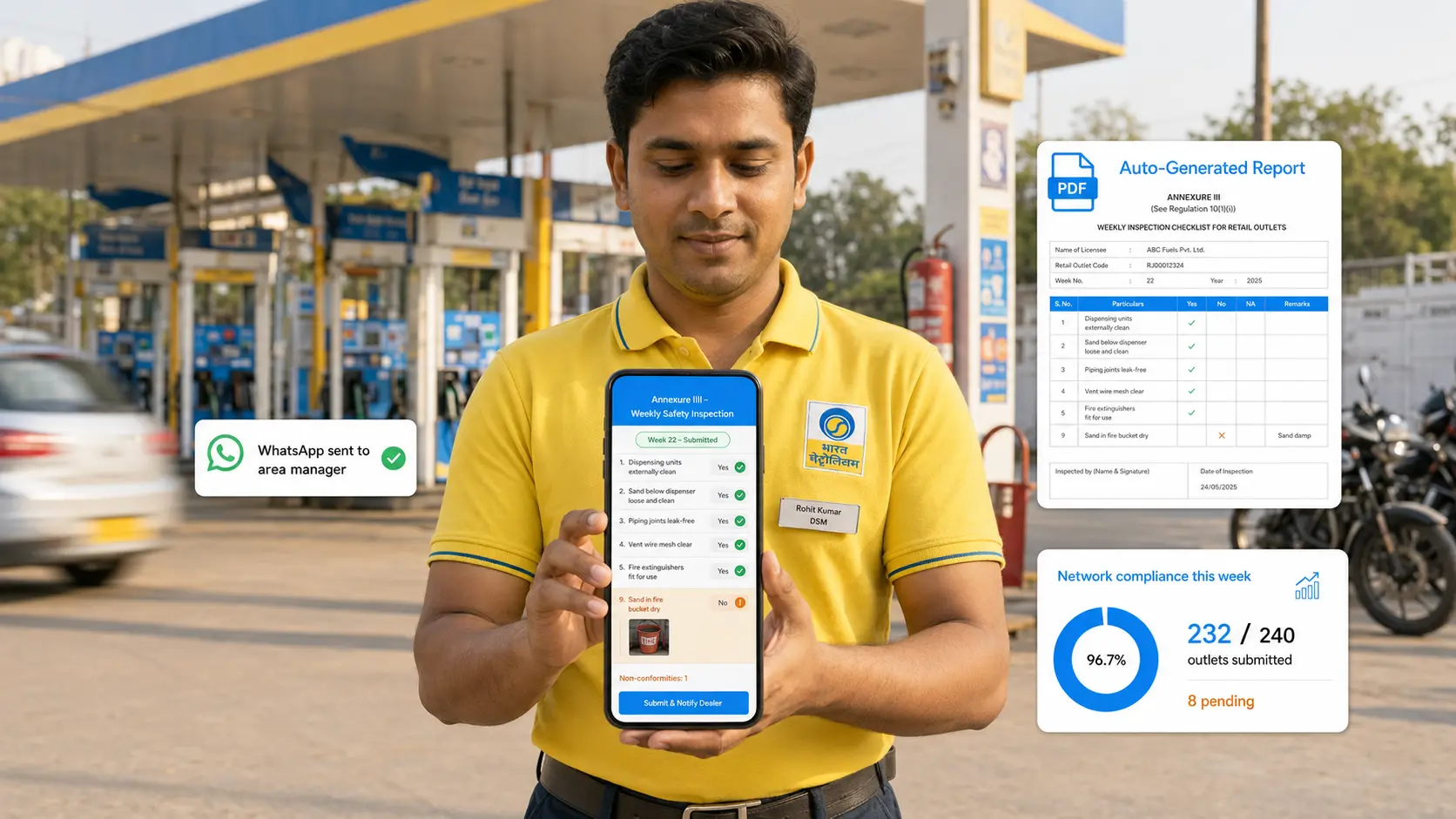
PNGRB Schedule 1, Annexure III prescribes a 15-item weekly safety inspection that every petroleum retail outlet in India must complete and record. The format looks simple on paper, but for a network running 50, 200, or 1,000 outlets it falls apart fast: checks get backdated, photos are missing, sand bucket conditions go unchecked, and TPIA auditors flag the gaps. This article walks through every item in Annexure III, what auditors actually look for, and how a Clappia PNGRB audit checklist app turns the weekly inspection into a five-minute mobile job. Where this fits in the wider stack: see the parent PNGRB checklist guide for the full picture.
Annexure III sits inside Schedule 1 of the PNGRB Technical Standards and Specifications including Safety Standards (T4S) Regulations, which govern every retail outlet dispensing MS, HSD, Auto LPG, CNG, LNG, and LCNG in India. The annexure prescribes the weekly safety inspection checklist that the outlet's own operating personnel must complete.
Three things about it that matter:
The records feed directly into the annual Annexure V safety audit and are scrutinised during every TPIA visit. A missing week is treated as a non-conformity.
The weekly check is the first line of defence at a petrol pump. Every higher-frequency PNGRB audit — the annual safety audit (Annexure V), the three-yearly electrical audit (Annexure IV), the TPIA conformity assessment — assumes that the weekly is being run honestly. If it isn't, the deeper audits surface preventable issues at the worst possible moment.
What this looks like in practice:
Annexure III is short on purpose: 15 items, doable in under ten minutes. The question is not "is it long enough" but "is it actually being done and evidenced".
This is the full item list from the regulation, with what auditors look for under each one.
| Annexure III need | Clappia feature |
|---|---|
| Scan each dispenser, tank, fire extinguisher, and vent before logging the check | QR code and barcode scanner for asset-level traceability |
| Prove the DSM was physically at the outlet | GPS location block auto-captures coordinates on form open |
| DSM and dealer sign-off | Digital signature blocks for both parties |
| Mandatory photo on every "No" response | Camera and file upload block triggered by conditional logic |
| Auto-generated PDF in the Annexure III format | Print Settings templates that fill every variable, embed photos, and stamp signatures |
| Alert the dealer and area manager when non-conformities are logged | WhatsApp, Slack, email, and SMS workflow nodes |
| Track weekly submission rate across every outlet in the network | Live dashboards with filters by outlet, region, week, and item |
| Run the check at outlets with poor connectivity | Offline mode by default on Android and iOS |
| Field-only mobile UX for DSMs | Clappia mobile app with shift-friendly UI |
Build your weekly inspection app on Clappia in minutes, free forever.
Get Started For FreeThe regulation says the weekly inspection is to be done by operating personnel (DSMs) on rotational basis. Two things flow from that:
Frequency is weekly, but most successful networks run it on a fixed day (e.g., every Wednesday morning before peak hours). Fixed-day cadence makes missed weeks obvious instantly.
The T4S Regulations require the weekly inspection records to be:
Paper records technically satisfy "maintained". They fail on "available" the moment the sheet is misplaced, and they fail on "trended" because no dealer is going to manually graph 52 weekly sheets.
If you're moving Annexure III off paper, the form needs to capture every regulatory field and a few that make the data useful afterwards.
Identity and context:
The 15 items themselves:
Evidence and sign-off:
Computed fields:
This is the field-by-field mapping. No coding, all drag-and-drop on the Clappia designer.
| Annexure III need | Clappia feature |
|---|---|
| Scan each dispenser, tank, fire extinguisher, and vent before logging the check | QR code and barcode scanner for asset-level traceability |
| Prove the DSM was physically at the outlet | GPS location block auto-captures coordinates on form open |
| DSM and dealer sign-off | Digital signature blocks for both parties |
| Mandatory photo on every "No" response | Camera and file upload block triggered by conditional logic |
| Auto-generated PDF in the Annexure III format | Print Settings templates that fill every variable, embed photos, and stamp signatures |
| Alert the dealer and area manager when non-conformities are logged | WhatsApp, Slack, email, and SMS workflow nodes |
| Track weekly submission rate across every outlet in the network | Live dashboards with filters by outlet, region, week, and item |
| Run the check at outlets with poor connectivity | Offline mode by default on Android and iOS |
| Field-only mobile UX for DSMs | Clappia mobile app with shift-friendly UI |
Once the DSM hits submit, the regulation is silent on what happens next, but the practical reality is that the submission has to go somewhere and trigger something. Here's what a working setup does:
Closure is tracked. The same app the DSM uses to log the issue is the app the dealer uses to mark it closed, with a closure photo and a closure signature.
A network HSE lead at a major Indian oil marketing company manages weekly inspections across 240 petroleum retail outlets in two states. Before going digital, paper Annexure III sheets came in by courier once a quarter. About 30% arrived incomplete, 10% never arrived, and the rest were impossible to trend.
After moving to the Clappia PNGRB audit checklist app, every DSM submits the weekly Annexure III check from a phone with mandatory photos on every "No". The dashboard shows compliance by outlet, by region, and by item. The recurring patterns surface fast: in 22 outlets, item 9 (sand bucket condition) was failing two weeks out of every five, traced to monsoon humidity in coastal regions. The fix was to switch to sealed-lid buckets, network-wide, and the failure rate on item 9 dropped to near zero within a quarter. None of that pattern was visible on paper.
The weekly inspection is the most frequent check, but it is one of several. Use it alongside:
The operating personnel of the retail outlet, on rotational basis. In practice this means the DSMs on the outlet's roster take turns running the check week by week. The dealer or manager counter-signs.
The base 15 items are the same because they come from the PNGRB T4S Regulations. Some OMCs (HPCL, IOCL, BPCL, RIL, Nayara, Shell) add internal checks on top of Annexure III for their own brand or operations, but the regulatory minimum is identical.
A missed week is treated as a non-conformity. The annual Annexure V audit explicitly checks that weekly Annexure III records exist for every week of the year. TPIAs flag missing weeks in their conformity assessment reports.
No. The regulation is clear: weekly safety inspection is by the operating personnel of that outlet, on rotational basis. A different person doing the check from outside the outlet's roster is not a substitute, though a company-authorised person can run the parallel Annexure V annual audit.
About five to seven minutes for a DSM familiar with the app, including the four mandatory evidence photos. Most of that time is the walk between the dispensers, tank farm, and the sales room - the form itself takes under a minute to fill once you're at each station.
The weekly inspection is the smallest and most repeated checklist on the PNGRB stack, which makes it the best place to start when you go digital. Five minutes per outlet per week, mandatory photo evidence on every "No", instant routing of non-conformities to the right person, and a network dashboard that tells you which outlets are pulling their weight.
Ready to run Annexure III without paper? Sign up for free and build your first weekly inspection app on Clappia in under 10 minutes. No credit card, no contracts, no risk, just results.
 Get Started – It’s Free
L374, 1st Floor, 5th Main Rd, Sector 6, HSR Layout, Bengaluru, Karnataka 560102, India
3500 S DuPont Hwy, Dover,
Kent 19901, Delaware, USA


.svg)



3500 S DuPont Hwy, Dover,
Kent 19901, Delaware, USA
L374, 1st Floor, 5th Main Rd, Sector 6, HSR Layout, Bengaluru, Karnataka 560102, India

.jpg)

.avif)
.jpg)

